
Example of Bio About Yourself: 20+ Templates & Real Examples for Every Platform (2026)
Introduction: Why Your Personal Bio Matters More Than Ever
You've got three seconds. That's it.
Three seconds before someone scrolls past your LinkedIn profile, closes your website's "About" page, or swipes left on your Twitter bio. Your personal bio isn't just a formality—it's the digital handshake that determines whether someone wants to work with you, follow you, or even remember you.
Here's the problem: most people freeze when they try to write about themselves. The cursor blinks. The pressure mounts. You end up with something generic like "passionate professional with excellent communication skills" that sounds exactly like everyone else.
Whether you're a freelancer pitching clients, a job seeker standing out in a crowded market, an entrepreneur building authority, or a content creator growing your audience, you need a bio that actually works—not one that disappears into the noise.
This guide changes everything. You'll find 20+ real-world examples from people who've nailed their bios, along with fill-in-the-blank templates you can customize in minutes. We'll show you exactly what works on LinkedIn versus Instagram, how to adjust your tone for different platforms, and the specific formulas that turn awkward self-descriptions into magnetic introductions.
Ready to stop cringing at your own bio? Let's transform that blank page into something you're proud to share.
What Makes a Great Personal Bio? (Key Elements Breakdown)
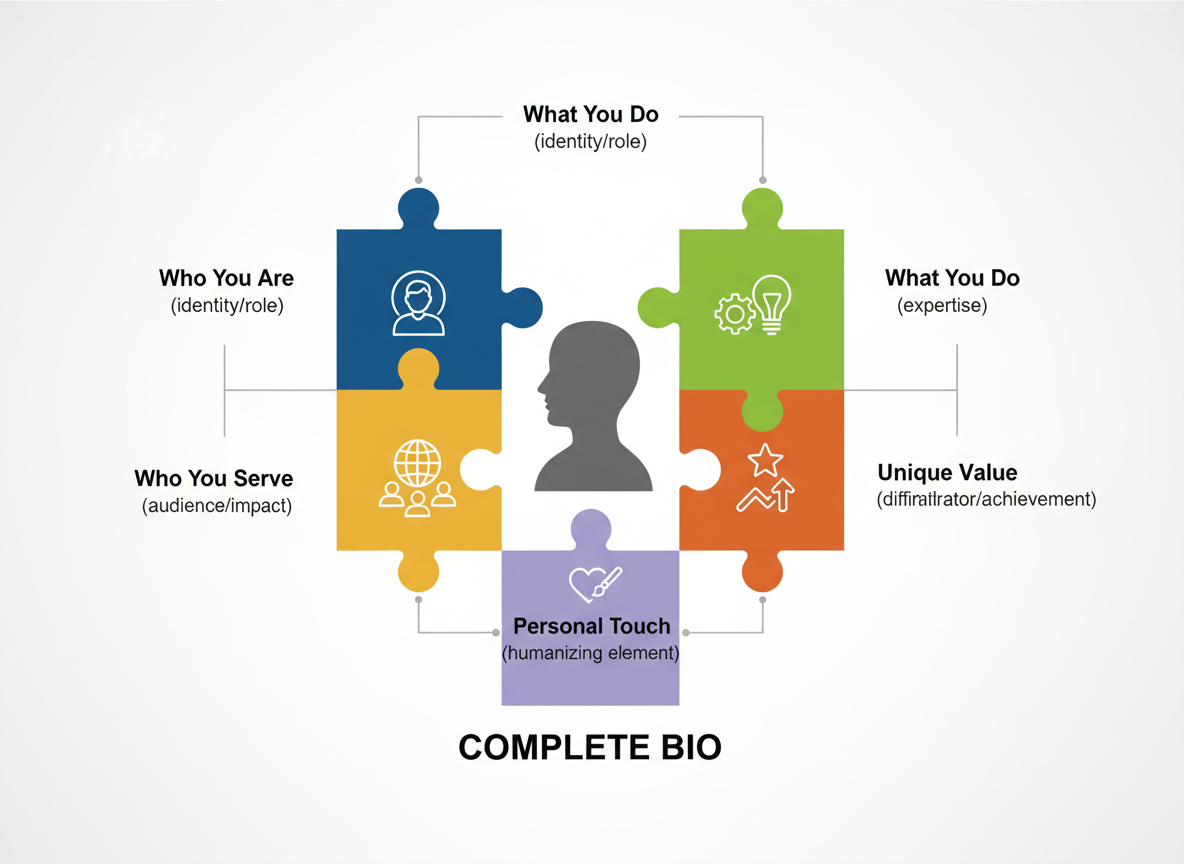
Your bio isn't just a list of facts about you—it's your handshake, your elevator pitch, and your first impression rolled into one. The bios that actually work share five essential components.
The Five Building Blocks
First, who you are establishes your identity beyond your job title. Second, what you do explains your work in plain language anyone can understand. Third, who you serve clarifies your audience or clients. Fourth, your unique value or achievement sets you apart from everyone else with your same title. Finally, a personal touch humanizes you—maybe you're a dog person, a coffee addict, or a terrible golfer.
Here's the thing: specificity always beats generality. "Marketing consultant" says nothing. "I help SaaS startups triple their email open rates" tells a story. Research shows people remember concrete details 40% better than vague descriptions.
Tone Matters More Than You Think
Match your bio's personality to where it'll live. LinkedIn bios lean professional but personable. Instagram bios can be playful. Your company's About page sits somewhere in between. A tech CEO's bio shouldn't read like a comedian's press kit.
Length Depends on Context
You'll need different versions for different platforms. Twitter allows 160 characters. Your website can handle 300 words. Speaking engagements might require 500. We'll break down exactly when to use each format later.
Skip These Traps
Buzzwords like "passionate thought leader driving synergies" make readers glaze over. Vague claims without proof fall flat. And dumping every credential you've earned since high school? That's not a bio—it's a résumé nobody asked for.
Bio Length Guide: One-Liner, Short, Medium, and Long Formats
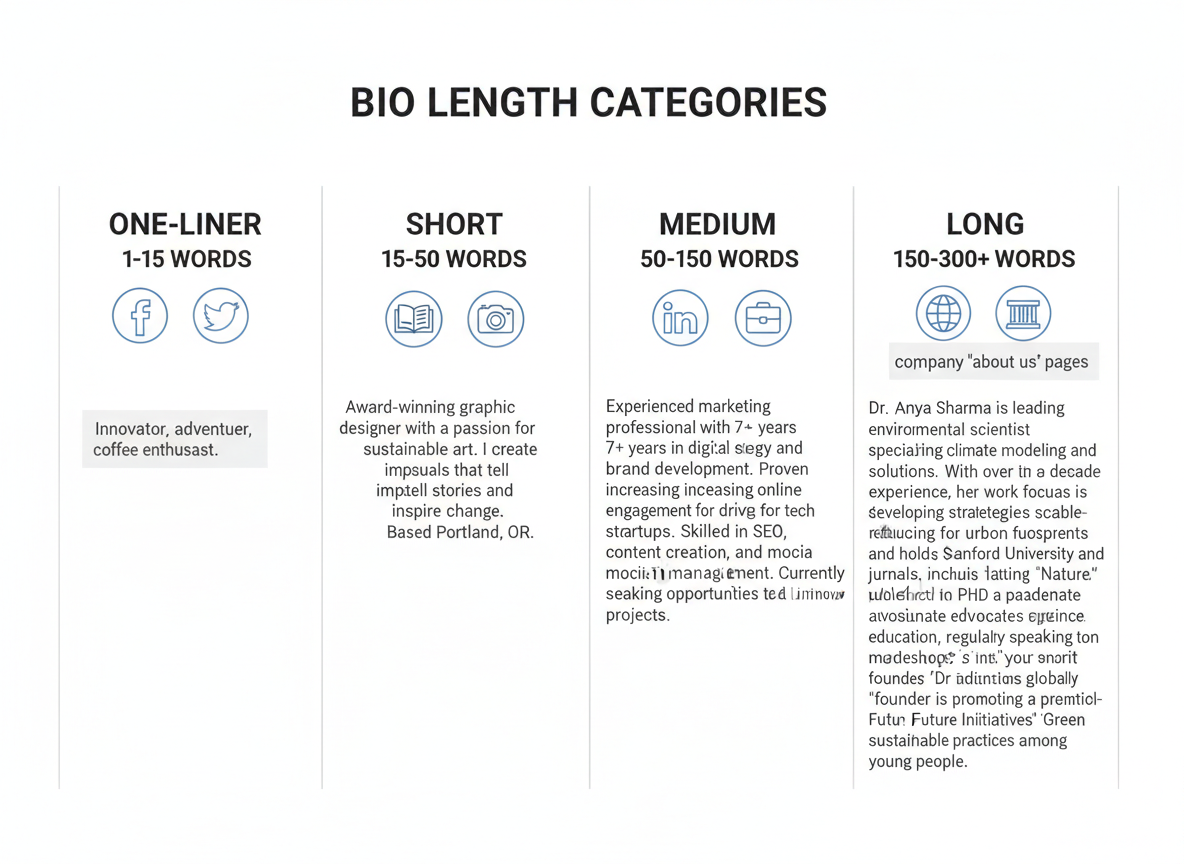
Choosing the right bio length isn't just about word count—it's about matching the platform's expectations and your audience's attention span.
One-liner bios (10-20 words) pack your essence into a single sentence. Think email signatures, social media handles, or speaker introductions. Example: "Marketing strategist helping B2B brands turn content into revenue. Coffee enthusiast. Based in Austin."
Short bios (50-75 words) give you breathing room to add context without losing anyone's attention. They're perfect for bylines, author boxes, conference programs, and Twitter/X profiles. You'll include your current role, one achievement, and maybe a personal touch.
Medium bios (100-150 words) let you tell a mini-story. LinkedIn summaries, website About pages, and guest post submissions benefit from this format. Here's where you can weave in your background, expertise, and what makes your approach different.
Long bios (250-350 words) give the full picture. Save these for speaker pages, executive profiles, and personal websites where people actively want to know more about you.
Here's the trick: write your long bio first, then trim it down for shorter versions. Keep your core message consistent across all formats, adjusting details rather than changing your story completely. Each version should feel complete on its own, not like a rushed summary.
20+ Personal Bio Examples for Different Scenarios
You're about to see real-world bio examples that work—sorted by profession and situation so you can find what fits your life right now.
Each example includes the actual bio text, where it works best, and why it connects with readers. We've organized them to save you time: students, freelancers, entrepreneurs, job seekers, creatives, professionals, and career changers all get their own spotlight.
Here's what matters: these aren't templates to copy word-for-word. They're inspiration. Notice the structure, the tone, the way each person highlights what makes them different. Then adapt those elements to your story.
A graphic designer's bio won't sound like a financial consultant's, and that's exactly the point. Your industry, personality, and goals should shape every sentence. Use these examples as your starting point, then make them unmistakably yours.
Ready? Let's look at what actually works across different platforms and professions.
Student & Recent Graduate Bio Examples
Example 1: College student seeking internship
"Marketing major at UCLA with a knack for turning data into stories. Currently leading social media strategy for three campus organizations, growing combined followers by 240% in six months. Proficient in Google Analytics, Canva, and content scheduling tools. Seeking summer internship to bring fresh ideas and proven results to a dynamic marketing team."
Example 2: Recent graduate transitioning to workforce
"Recent communications graduate passionate about helping brands find their voice online. During my final year at Boston University, I managed content strategy for a local nonprofit, creating campaigns that doubled their email engagement and attracted 500+ new donors. I combine storytelling skills with SEO fundamentals and analytics to create content that connects with real people. Currently exploring content marketing roles where I can blend creativity with strategy."
Example 3: Graduate student/researcher
"PhD candidate in Environmental Science at Stanford University, researching sustainable water management systems in urban environments. My dissertation examines policy frameworks across twelve major cities, with findings published in the Journal of Environmental Studies. I present research at conferences and collaborate with municipal planning departments to translate academic insights into actionable solutions."
What works: These bios emphasize relevant projects, measurable achievements, and genuine enthusiasm. They showcase what you've already accomplished rather than what you lack.
Common pitfall to avoid: Never apologize for being "new" or having "limited experience." Your education, projects, and fresh perspective are assets.
Freelancer & Consultant Bio Examples
Example 4: Freelance Writer/Content Creator (Short Format)
"I help SaaS companies turn complex features into clear, conversion-focused content. Published in TechCrunch, VentureBeat, and Forbes. Let's make your product story unmissable."
Example 5: Marketing Consultant (Medium Format)
"Over the past 7 years, I've helped 40+ e-commerce brands increase their email revenue by an average of 127%. My approach combines behavioral psychology with data-driven testing to create campaigns that actually convert. Former Head of Marketing at two seven-figure DTC brands. Now I work with ambitious founders who know their email list is sitting on untapped revenue. Based in Austin, fueled by cold brew and A/B tests."
Example 6: Graphic Designer (Creative Tone)
"I design brands that make people stop scrolling and start caring. Specializing in bold, story-driven visuals for wellness and lifestyle businesses. My work has been featured in Design Milk and won two Webby Honorees. View my portfolio at [link] or let's chat about your next project."
Example 7: Virtual Assistant (Client-Benefit Focused)
"I give entrepreneurs their time back. From inbox management to calendar coordination and client onboarding, I handle the tasks that keep you from doing your best work. My clients reclaim an average of 15 hours per week."
What works: These bios lead with specific services and measurable results. They focus on client benefits rather than just listing credentials. Notice how each has personality while staying professional.
Tip: Start with the transformation you provide, not your job title. "I help X achieve Y" beats "I'm a consultant with 10 years of experience" every time.
Entrepreneur & Business Owner Bio Examples
Example 8: Startup Founder (Medium Format, Mission-Driven)
"I started GreenPath after watching my hometown struggle with accessible recycling options. Now we've partnered with 300+ municipalities to make sustainable waste management simple and affordable. Before founding GreenPath in 2019, I spent eight years in supply chain logistics at Fortune 500 companies—experience that taught me efficiency, but not purpose. Featured in TechCrunch and Sustainability Today. Stanford MBA, certified B-Corp enthusiast, weekend trail runner."
Example 9: Small Business Owner (Conversational, Community-Focused)
"Hey! I'm Maria, and I run Cozy Corner Café in downtown Portland. We're the spot where your morning coffee comes with actual conversation (remember those?). I left corporate marketing five years ago because I wanted to build something real. Now we're a hub for local artists, remote workers, and anyone who thinks coffee tastes better when it supports local farmers. Come say hi—I'm usually behind the counter or testing new pastry recipes."
Example 10: E-commerce Entrepreneur (Results and Story Blend)
"Built my jewelry brand from my kitchen table to $2M in annual revenue. What started as a side project while teaching high school became Luna & Stone—handcrafted pieces worn by 15,000+ customers worldwide. I handle everything from design to customer service, proving you don't need venture capital to build something meaningful. Featured in Etsy's Seller Success Stories."
Example 11: Solopreneur/Coach (Personal Brand Emphasis)
"I help burned-out professionals redesign their careers without starting from scratch. After my own corporate exit in 2020, I've coached 200+ clients through strategic pivots. Certified career strategist, former HR director, believer in sustainable success over hustle culture."
What Works: Origin stories create connection. Mission statements give context. Specific metrics build credibility without bragging. Balance authority with warmth by mixing achievements with personality.
Job Seeker & Career Changer Bio Examples
Changing careers or job hunting? Your bio needs to position you as a solution, not someone apologizing for your journey.
Example 12: Mid-Career Professional (LinkedIn)
"After 8+ years building high-performing marketing teams at tech startups, I'm seeking my next leadership challenge. I've scaled content operations from zero to 50K monthly readers, managed budgets exceeding $500K, and mentored 15+ junior marketers into senior roles. Currently exploring opportunities where I can combine strategic vision with hands-on execution to drive measurable growth. Open to remote or hybrid roles in B2B SaaS."
Example 13: Career Changer
"Transitioning from 6 years in education to instructional design. My classroom experience taught me how people actually learn—not just what sounds good in theory. I've designed curriculum for 200+ students, created digital learning materials, and adapted complex concepts for diverse audiences. Now bringing those skills to corporate training and e-learning development."
Example 14: Returning After Gap
"Marketing strategist returning after 3 years focusing on family. Previously drove 180% revenue growth at a boutique agency and managed campaigns for 20+ clients. During my break, I completed certifications in SEO and analytics while consulting part-time. Ready to bring fresh energy and updated skills to a growth-focused team."
What works: These examples frame every experience as an asset. They're forward-looking without dwelling on transitions. No apologizing, no explaining—just value.
Creative Professional Bio Examples
Creative professionals get to break the rules—and honestly, you should. Your bio is another canvas for your craft.
Example 15: Photographer
"I chase light the way some people chase deadlines. For the past eight years, I've documented stories that newspapers won't tell—street life in São Paulo, disappearing fishing villages in Vietnam, and underground art communities across Eastern Europe. My work has appeared in National Geographic, The Guardian, and on gallery walls where people actually stop and look. Based in Brooklyn, available worldwide. Currently working on a project about urban rooftop farmers."
Example 16: Author/Writer
"Three novels, two screenplays, and one memoir my mother wishes I hadn't written. My debut, Midnight at the Edison, won the 2024 Pen/Faulkner Award and taught me that wine-drunk editing is not, in fact, a viable strategy. I write literary fiction that makes you miss your subway stop. Represented by Sterling Lord Literistic. Currently destroying my third marriage—just kidding, it's only my second draft."
Example 17: Artist
"I paint what anxiety looks like when it can't find words. Working primarily in acrylics and mixed media, I create abstract pieces that explore mental health, identity, and the weird space between chaos and control. My work hangs in private collections across North America and occasionally in my dentist's office (long story). Studio based in Portland."
What works: These bios show personality instead of claiming it. The photographer's opening line tells you everything. The writer's voice matches their craft. When you're selling creativity, your bio needs to prove you've got it.
Professional & Executive Bio Examples
When you're operating at the executive level, your bio carries weight. It needs to showcase accomplishments without reading like a resume on steroids.
Example 19: Corporate Executive
Maria Chen serves as Chief Innovation Officer at GlobalTech Solutions, where she's led the company's digital transformation initiatives resulting in $450M in revenue growth over four years. With 18 years in enterprise technology, she previously held leadership positions at Oracle and IBM. Maria holds an MBA from Stanford and regularly speaks at industry conferences on AI integration and organizational change. She's been featured in Forbes, WSJ, and Tech Leaders Magazine for her forward-thinking approach to business modernization.
Example 20: Industry Expert
As a supply chain optimization specialist with two decades of experience, David Rodriguez has helped Fortune 500 companies reduce operational costs by an average of 32%. He's authored three books on logistics management and consults with organizations navigating global distribution challenges.
Example 21: Speaker/Presenter
Jennifer Park transforms how teams communicate under pressure. Her keynotes blend neuroscience research with real-world crisis management experience from her decade leading communications at a major healthcare system. She's spoken at TEDx and delivered workshops for companies like Microsoft and Johnson & Johnson.
Example 22: Board Member
Robert Thompson brings 25 years of financial expertise to three nonprofit boards, having previously served as CFO for a $2B healthcare organization. His strategic guidance has helped organizations improve fiscal sustainability and expand community impact.
What works: These examples balance prestige with personality, using specific metrics and outcomes rather than vague claims.
Fill-in-the-Blank Bio Templates (By Purpose)
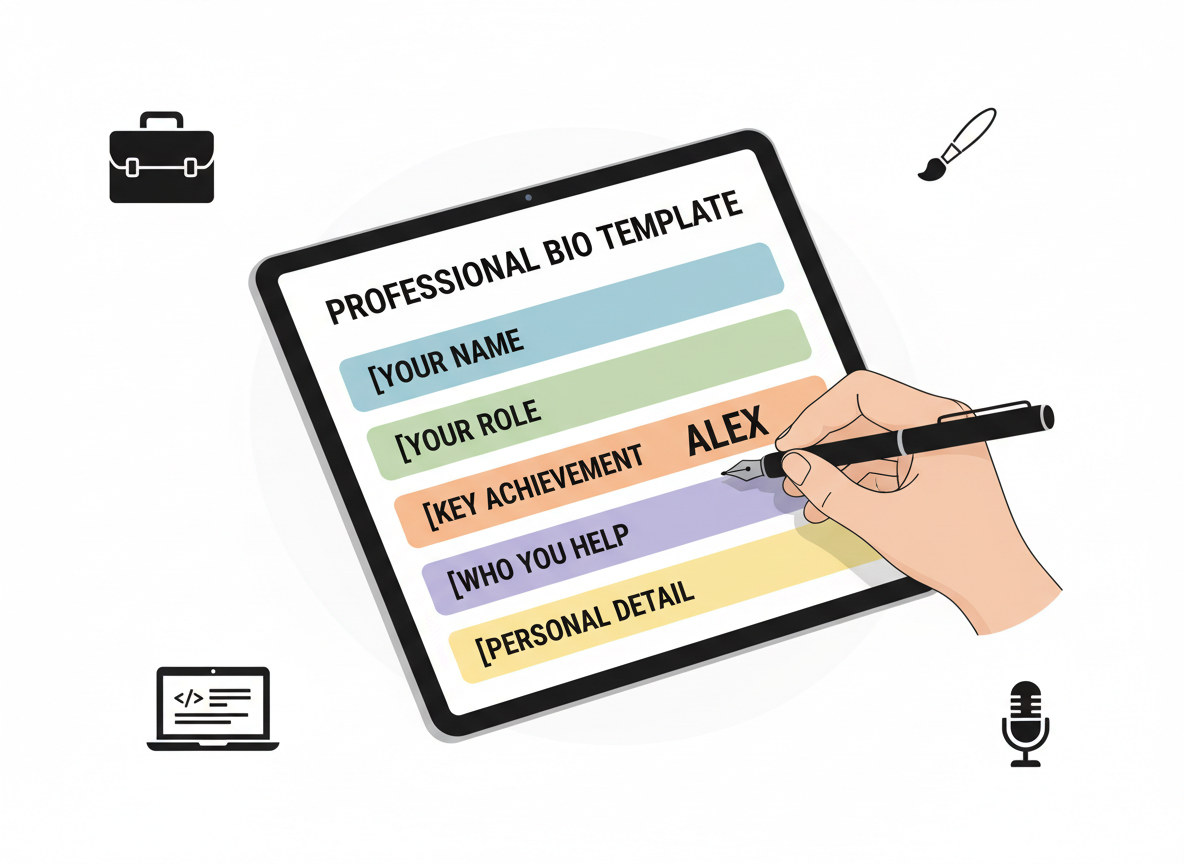
Ready to build your bio without staring at a blank screen? These fill-in-the-blank templates give you a proven structure—just add your details.
Template 1: General Professional Bio[Your name] is a [job title/role] with [X years] of experience in [industry/field]. Specializing in [your core expertise], [he/she/they] helps [target audience] achieve [specific outcome]. [Your name] has worked with [notable clients/companies/achievements] and holds a [relevant degree/certification] from [institution]. When not [working/creating/consulting], you'll find [him/her/them] [personal interest that adds personality].
Template 2: Creative Professional Bio Hi, I'm [your name]—a [creative role] who believes [your unique philosophy or approach]. I've spent the last [X years] [what you create/do] for brands like [client examples]. My work has been featured in [publications/platforms]. I'm obsessed with [your creative passion] and fueled by [coffee/music/whatever keeps you going]. Let's make something [adjective that describes your style] together.
Template 3: Service Provider Bio Struggling with [client pain point]? I help [target clients] [transformation you provide] through [your approach/method]. With [X years/credentials], I've helped [number] clients [specific result]. My approach focuses on [what makes you different], so you get [client benefit] without [common frustration]. Ready to [desired outcome]? Let's talk.
Template 4: Thought Leader/Expert Bio[Your name] is a recognized authority on [your expertise area]. As [your role/title], [he/she/they] has [major achievement or contribution]. [Your name]'s insights have shaped [industry impact] and appeared in [media/publications]. [He/She/They] speaks at [types of events] and advises [who you advise] on [topics].
Template 5: Personal Brand Bio I wasn't always [current role]. [Brief origin story or turning point]. That's when I discovered [what you're passionate about]. Today, I [what you do] and help [audience] do the same. I've [notable achievement], but what matters most is [your mission or impact].
How to customize: Replace every [bracketed section] with your specific information. Keep what flows naturally, cut what doesn't fit your story.
Platform-Specific Bio Optimization Strategies
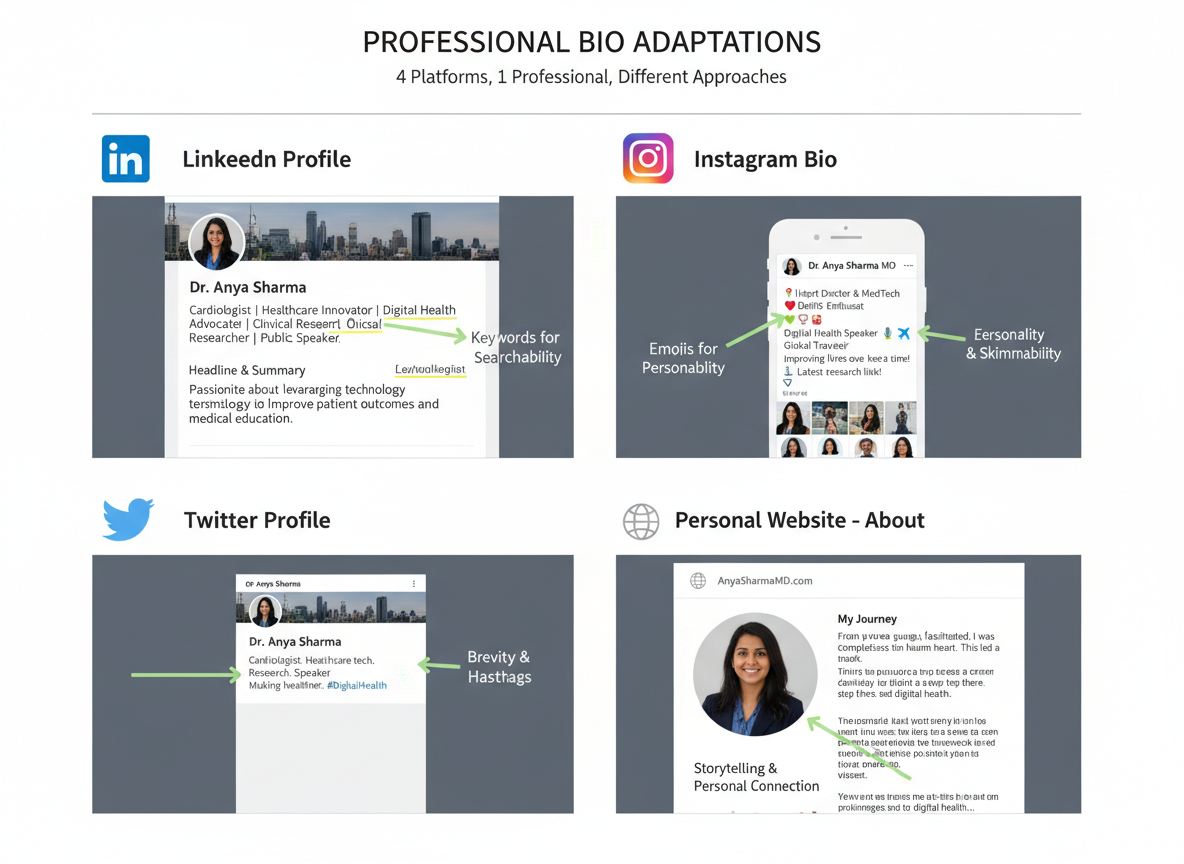
Your bio isn't one-size-fits-all. What works on LinkedIn will flop on Instagram, and your Twitter bio needs a completely different approach than your speaker bio. Here's how to adapt while staying authentically you.
LinkedIn: Your Professional Search Engine
Think of LinkedIn as Google for professionals. Pack your headline and summary with industry keywords people actually search for—"SaaS content strategist," "B2B email marketing specialist," or "fintech UX designer." Lead with quantifiable wins: "Increased client revenue by 340%" hits harder than "experienced marketer." Your first two lines matter most since they appear before the "see more" button.
Instagram: Personality in 150 Characters
You've got limited space, so make every word count. Use line breaks to create visual breathing room. Emojis aren't unprofessional here—they're functional signposts (🎯 for your offer, 📧 for contact info). Always include a clear call-to-action and rotate your link based on current priorities. "Link below for free template" beats "check out my website."
Twitter/X: Searchable Personality
Your 160 characters should balance what you do with who you are. Include searchable terms but skip the keyword stuffing. "Content strategist who accidentally became a cat influencer" tells a story while remaining discoverable. Coordinate with your pinned tweet—if your bio mentions podcasting, pin your latest episode.
Personal Website: The Full Story
Your About page can breathe. Start with a hook that resonates emotionally, then dive into your background, philosophy, and what makes you different. Break content into scannable sections with subheadings. Place multiple CTAs throughout—don't make people hunt for how to work with you. When managing multi-platform publishing, your website serves as home base where you can expand beyond character limits.
Conference Speaker Bios: Credibility First
Lead with why you're qualified to speak on this specific topic. Include relevant credentials, media mentions, or speaking history. Frame everything around audience benefit—not your ego.
Before & After: Bio Transformations That Work
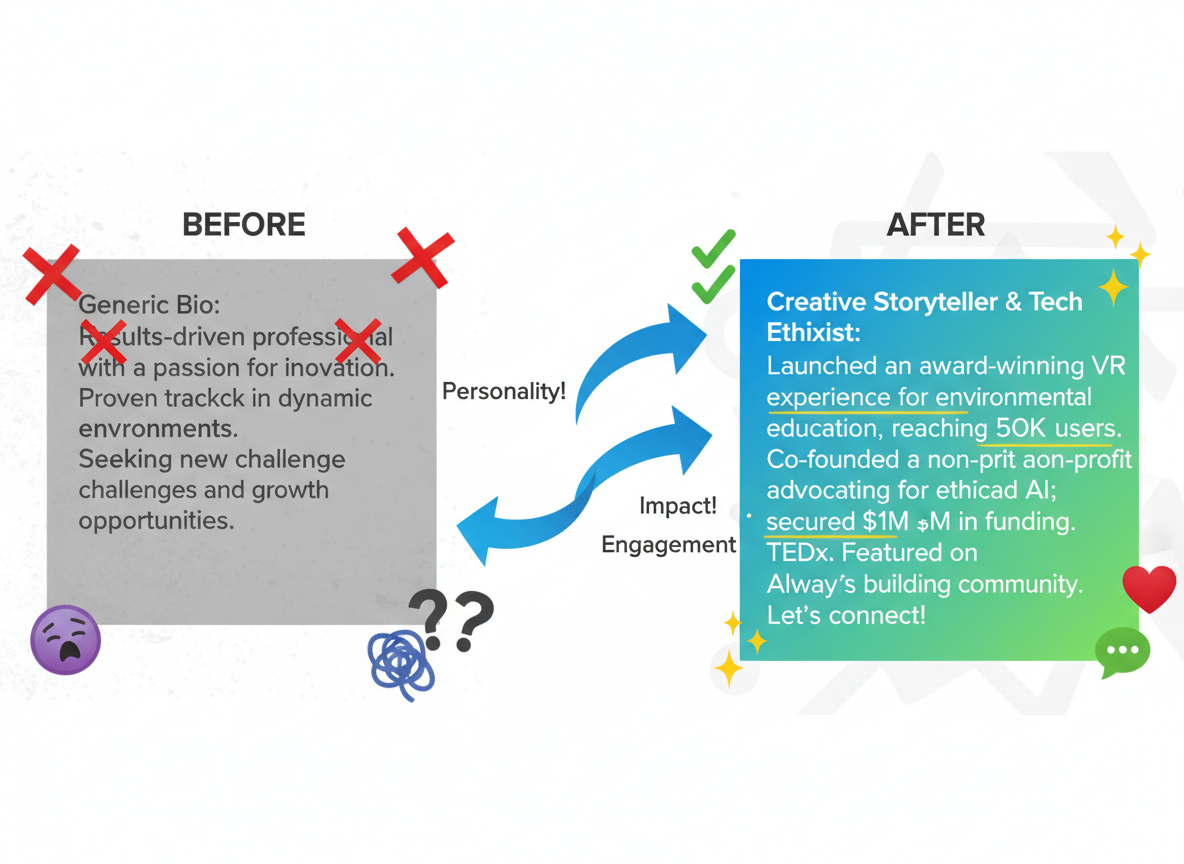
Let's look at real transformations that turned forgettable bios into magnetic ones.
Transformation 1: Generic to Specific
Before: "Marketing professional with experience in digital strategy and social media."
After: "I help SaaS startups turn cold LinkedIn connections into $10K+ consulting clients in 90 days."
The difference? The after version names the exact audience, the specific problem, and a measurable outcome. It's an example of bio about yourself that makes people think, "That's exactly what I need."
Transformation 2: Credential Dump to Story-Driven
Before: "MBA from Stanford. 15 years in finance. CFA certified. Published in Forbes."
After: "After burning out at Goldman Sachs, I built a financial coaching practice that's helped 200+ professionals escape the corporate grind without sacrificing their income."
The credentials matter, but the journey creates connection. The second version shows transformation, not just achievement.
Transformation 3: Timid to Confident
Before: "I'm just a freelance writer trying to help businesses with their content needs."
After: "I write conversion-focused copy that turns browsers into buyers—without the sleazy sales tactics."
Dump the self-deprecation. "Just a freelance writer" screams insecurity. The after version owns expertise and makes a bold promise.
Transformation 4: Boring to Memorable
Before: "Professional photographer specializing in weddings and events."
After: "I chase light, capture tears of joy, and make couples look like they belong in Vogue—even if they feel awkward in front of cameras."
The second version has personality, addresses a pain point, and creates a visual image.
The Pattern You'll Notice
Each transformation swaps vague language for specifics, replaces credentials with outcomes, and adds human warmth. These small shifts create massive differences in how people perceive—and remember—you.
First-Person vs. Third-Person: Which Should You Use?
Here's something that trips up even experienced writers: should your bio say "I help businesses grow" or "She helps businesses grow"? The answer depends entirely on where your bio lives and what you're trying to accomplish.
First-person works best when you're building a direct connection. Personal websites, freelancer profiles, creative portfolios, and social media bios feel more authentic in first-person. It's conversational and approachable—perfect when you want readers to feel like they're getting to know you.
Compare these versions:
First-person: "I'm a brand strategist who's helped over 200 startups clarify their messaging. When I'm not working with clients, you'll find me experimenting with sourdough."
Third-person: "Sarah is a brand strategist who has helped over 200 startups clarify their messaging. When she's not working with clients, she experiments with sourdough."
See the difference? The first-person version feels like you're having coffee together.
Third-person creates professional distance and authority. Speaker bios, corporate team pages, author boxes, and conference materials typically require third-person. It positions you as someone being introduced by a trusted source.
Can't decide? Try a hybrid approach: start with third-person credibility, then shift to first-person for personality. "Alex Chen builds SaaS products that scale. I believe great software should feel invisible."
Quick framework: Personal platform or creative field? Go first-person. Professional context or formal introduction? Choose third-person.
Common Bio Mistakes to Avoid (With Examples)
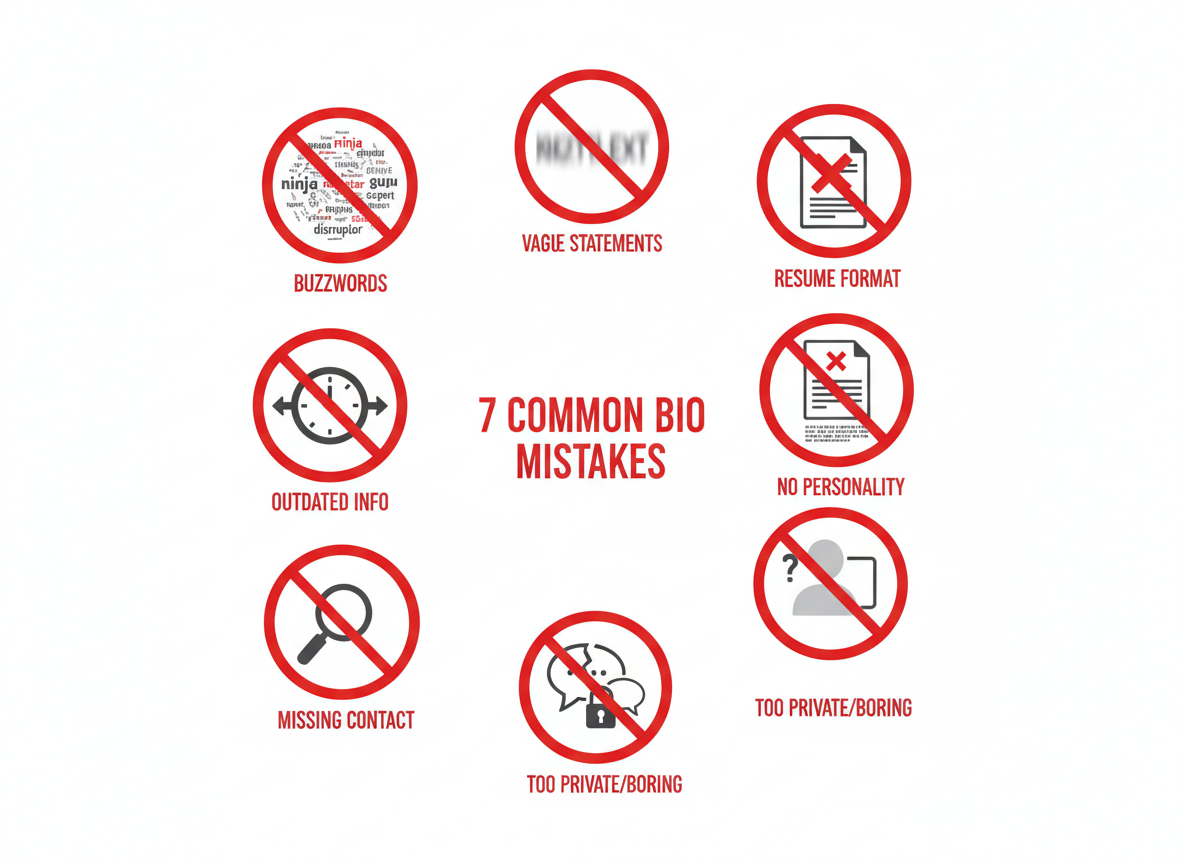
Even experienced professionals stumble when writing their own bios. Let's break down the mistakes that'll make readers click away—and how to fix them.
Mistake 1: Buzzword overload
"Passionate, innovative, strategic thought leader driving transformative solutions..."
Nobody talks like this in real life. If you wouldn't say it at a coffee meeting, don't write it in your bio.
Mistake 2: Being too vague or generic
"I help businesses grow online" tells readers nothing. Compare that to: "I help e-commerce stores increase checkout conversions through better product page design." See the difference?
Mistake 3: Leading with job title instead of value
Before: "Senior Marketing Manager with 10 years of experience." After: "I help SaaS companies turn website visitors into paying customers."
Lead with what you do for people, not what your business card says.
Mistake 4: Writing a resume instead of a bio
Credential dumping looks like this: "MBA, Harvard 2015. VP of Marketing, ABC Corp 2016-2019. Director of Strategy, XYZ Inc 2019-2022..."
Your bio isn't LinkedIn's experience section. Choose your most relevant accomplishments, not all of them.
Mistake 5: Forgetting the human element
All work, no personality makes you forgettable. Share what makes you human—your weekend projects, what you're currently learning, or why you actually care about your work.
Mistake 6: Underselling yourself or over-apologizing
"I'm still learning, but..." or "I'm not an expert, however..." undercuts everything that follows.
Mistake 7: Outdated information
Referencing a 2019 award or outdated job title screams "I don't update my profiles."
Spot these mistakes in your bio: Read it aloud. Does it sound like something you'd actually say? Would someone understand what you do after one read? If you hesitated on either question, you've got work to do.
Writing Tips for Introverts and the Self-Promotion Averse
If writing about yourself feels uncomfortable, you're not alone. Here's a better way to think about it: your bio isn't bragging—it's helping people understand whether you're the right person to solve their problem.
Start by writing in third person. It creates psychological distance that makes self-promotion feel less awkward. "Sarah helps e-commerce brands increase conversions through data-driven email campaigns" feels easier to write than "I help..." You can always convert it to first person later if needed.
Shift your focus to outcomes, not accolades. Instead of "Award-winning designer with 15 years of experience," try "I've redesigned 200+ websites that increased user engagement by an average of 40%." See the difference? One sounds like a résumé; the other shows actual value.
Let testimonials do the heavy lifting. Weave in what others have said: "Clients describe my approach as 'refreshingly straightforward' and appreciate how I translate complex analytics into actionable strategies."
Use 'we' language when it fits. "We've helped over 500 small businesses" acknowledges your team and feels less self-centered than constant "I" statements.
Start with simple facts—where you work, what you do, how long you've done it. Facts aren't bragging; they're just information. Build from there, adding one accomplishment at a time until you've created something that feels genuine rather than performative.
How to Make Your Bio Memorable and Engaging
Here's what separates forgettable bios from ones people actually remember: specificity.
Your brain files away concrete details but glosses over vague claims. Compare "I've helped many clients grow their businesses" with "I've helped 127 startups raise $43M in seed funding." The second version sticks because it's real, tangible, verifiable.
But numbers aren't the only path to memorability. An unexpected detail creates a mental hook. If you're a tax accountant who's also a competitive salsa dancer, that contrast makes you unforgettable. That contrarian position you hold? Share it. People remember what surprises them.
Sensory language works magic too. Instead of "I create content," try "I craft stories that make readers forget they're supposed to be working." Feel the difference?
The story snippet technique gives people just enough narrative to want more: "After my startup crashed spectacularly in 2019, I learned what actually drives customer loyalty." You've created intrigue in one sentence.
Humor belongs in your bio if it fits your brand. A software developer might write, "I turn coffee into code and bugs into features (occasionally on purpose)." Just make sure it lands—test it on a friend first.
Your closing line needs punch. Don't let your bio fade with "...and much more!" End with impact: a bold claim, your mission, or what you're building next.
The 24-hour recall test: If someone can't remember one specific thing about you tomorrow, rewrite it.
When and How to Update Your Bio
Your bio isn't a "set it and forget it" piece of content. Think of it like your profile picture—what worked three years ago probably needs an update.
Trigger Events That Demand a Bio Refresh
Got a promotion? New certification? Shifted your target audience? These are clear signals to revisit your bio. Major achievements, skill evolution, or business rebranding should all prompt immediate updates. If you're still listing yourself as "aspiring entrepreneur" but you've been running a six-figure business for two years, you're doing yourself a disservice.
The Quarterly Review Practice
Set a recurring calendar reminder every three months. It takes 15 minutes to audit your bio across platforms and ask: "Does this still represent me?" You'll catch outdated information before it becomes embarrassing.
Version Control Matters
Maintain separate bio versions for different platforms and purposes. Your LinkedIn bio shouldn't be identical to your Instagram one. Keep a master document with your professional version, casual version, speaker bio, and ultra-short version ready to deploy.
Testing What Works
Track which bio versions get better results. More profile clicks? Higher engagement? Connection requests from your ideal clients? That's data worth paying attention to.
If you're publishing content regularly (like with automatic daily publishing), your bio should reflect your current offerings and expertise. A quick refresh updates one or two lines. A complete rewrite changes your positioning entirely. Choose wisely.
Bio SEO: Making Your Personal Bio Discoverable
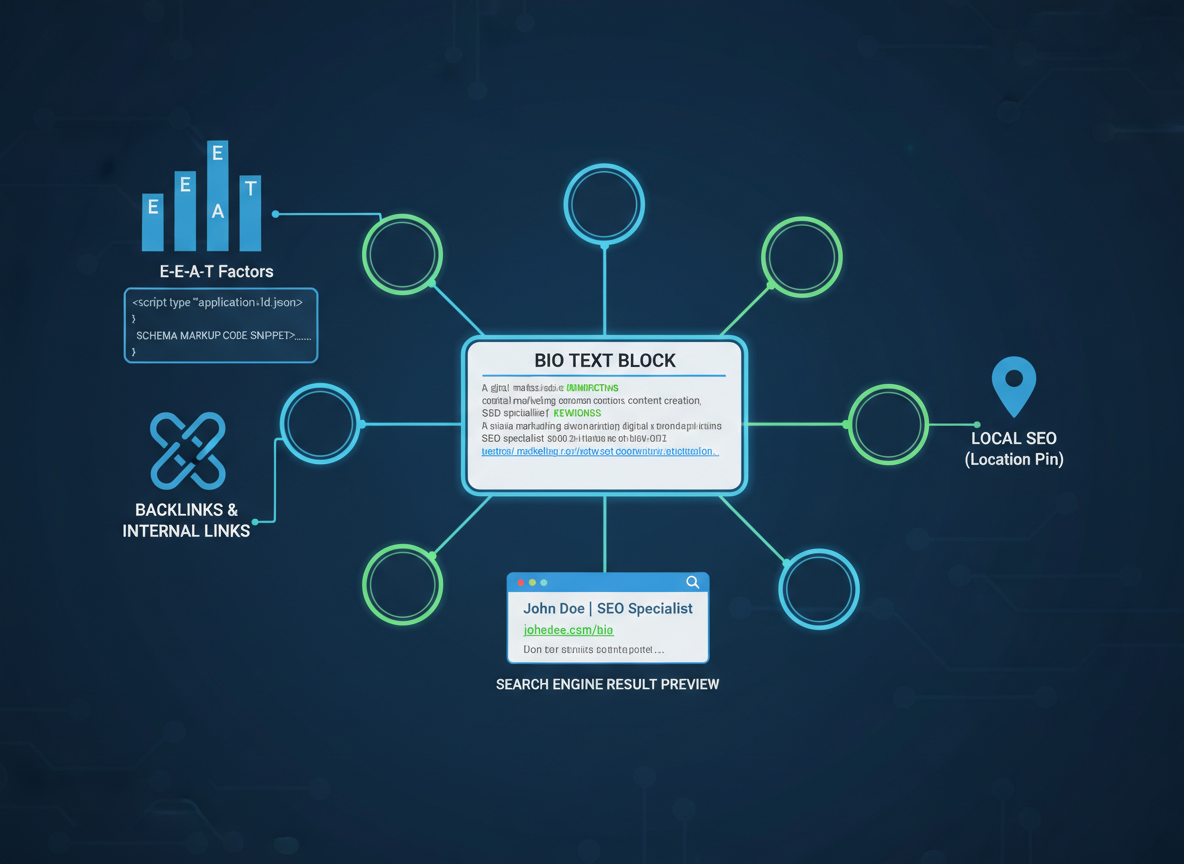
Your bio won't help you if people can't find it. Think about how potential clients or employers actually search. They're not typing "John Smith copywriter"—they're searching "B2B SaaS copywriter with tech background" or "freelance content writer for fintech startups."
Start by identifying these search patterns. What pain points do you solve? What specific niches do you serve? Those phrases belong in your bio, woven naturally into your story. Don't stuff "digital marketing expert" five times—instead, describe yourself as a "digital marketing strategist specializing in conversion optimization for e-commerce brands."
Google's E-E-A-T framework rewards bios that demonstrate real experience and expertise. Show, don't just tell. Instead of claiming you're "trustworthy," mention your ten-year track record or industry certifications. Link to your published work, portfolio, or speaking engagements. These outbound links signal credibility.
Consistency matters more than you'd think. Use the same name format, job title, and key descriptors across LinkedIn, your website, Medium, and Twitter. This helps Google connect the dots and recognize you as a distinct entity.
For location-based professionals, geographic signals work wonders. "Family law attorney in Austin, Texas" beats "passionate legal advocate" when someone's searching locally.
Want to take this further? Proper SEO and AEO optimization ensures your bio shows up not just in search results, but in AI-powered answers and voice searches too. Schema markup on your website tells search engines exactly who you are and what you do.
Your Bio Writing Action Plan (Step-by-Step)
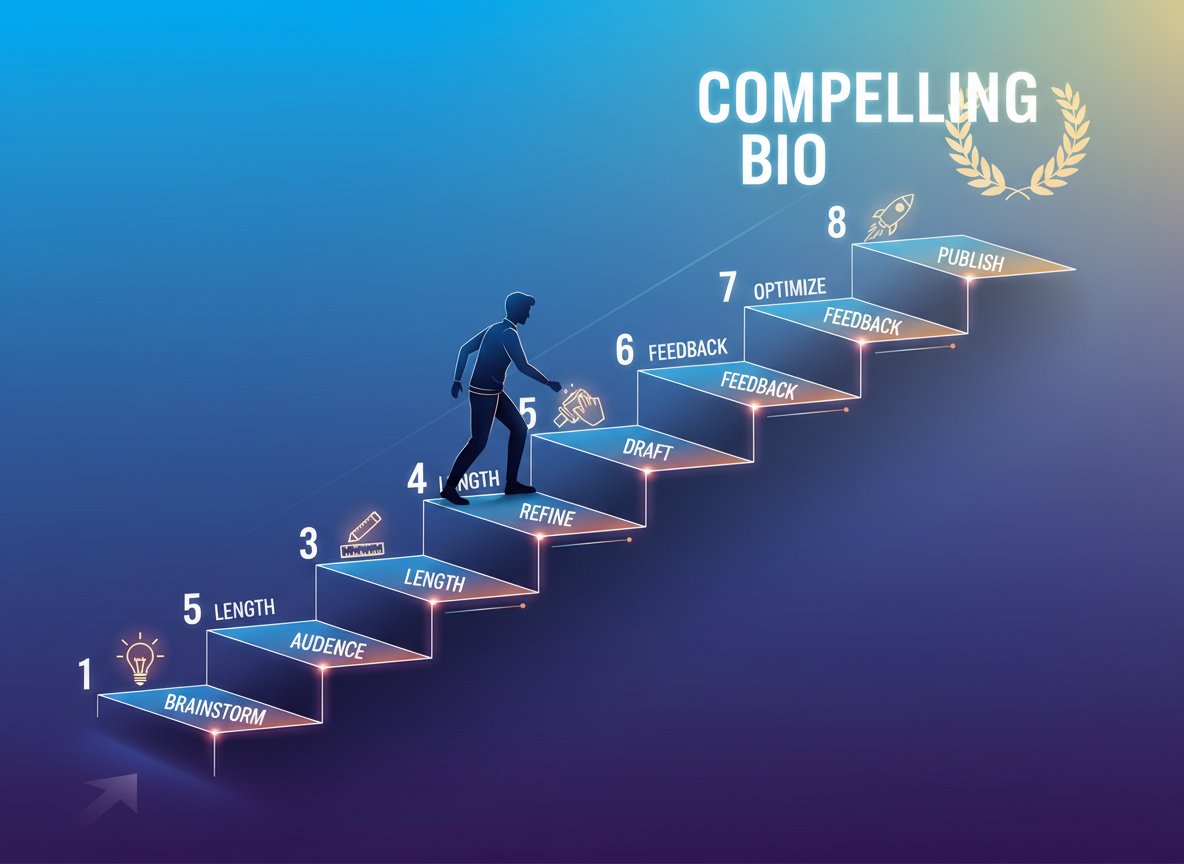
Step 1: Inventory Your Achievements
Grab a notebook and spend 15 minutes listing your skills, accomplishments, certifications, and what makes you different. Don't filter yet—just brain-dump everything worth mentioning.
Step 2: Define Your Audience and Purpose
Who's reading this bio? What do you want them to do afterward? A LinkedIn bio targeting recruiters needs a different angle than an Instagram bio attracting clients. Get clear on the outcome.
Step 3: Choose Length and Perspective
Match your approach to the platform. Twitter demands brevity. Your website allows storytelling. First-person feels personal; third-person adds authority. Pick what fits.
Step 4: Draft Using Templates
Start with an example of bio about yourself from earlier sections. Swap in your details. This beats staring at a blank screen.
Step 5: Refine for Impact
Cut the fluff. Replace vague claims ("experienced professional") with specifics ("managed $2M in ad spend"). Add one personality detail that makes you memorable.
Step 6: Get Feedback
Share your draft with someone who knows your work. They'll catch what you're too close to see.
Step 7: Optimize for Platform
Add relevant keywords naturally. Include links where allowed. Check character limits.
Step 8: Publish and Track
Post it, then monitor engagement. Are people clicking your links? Reaching out?
Bonus: Set a Reminder
Mark your calendar to review your bio quarterly. Your story evolves—your bio should too.
Conclusion: Your Bio Is Your Digital Handshake
Your bio isn't just a formality—it's working for you 24/7, making first impressions while you sleep. Whether someone discovers you on LinkedIn, scrolls past your Instagram, or lands on your website, that short paragraph shapes how they see you and whether they'll engage.
You've now got 20+ examples, templates, and proven strategies to write bios that actually connect. No more staring at a blank screen wondering how to describe yourself without sounding awkward or arrogant.
Here's the truth: writing about yourself gets easier every time you do it. Your first draft won't be perfect, and that's completely fine. Start with one bio today. Pick the platform that matters most to your goals right now and use the templates we've covered. Then refine it as you go.
Remember to update your bios regularly—every promotion, new skill, or pivot in your career deserves to be reflected in your digital introduction.
And just as a great bio automates your personal introduction, tools like AI-powered blog content automation can automate your entire content presence, keeping your digital footprint fresh while you focus on growth.
Now go write that bio. You've got this.
Frequently Asked Questions
How long should a personal bio be?
It depends entirely on where you're using it. Twitter bios max out at 160 characters, so you'll need laser focus there. Instagram gives you 150 characters—enough for your core value and a call-to-action. LinkedIn's 2,600-character limit lets you tell a fuller story, while professional websites can accommodate 200-500 words. Speaker bios typically run 100-150 words. Your best bet? Write a long version first, then trim it down for each platform.
Should I write my bio in first person or third person?
First person ("I help") feels approachable and works great for social media, personal websites, and creative fields. Third person ("She specializes in") adds credibility for conference programs, author pages, and corporate settings. When in doubt, match what others in your industry are doing—but don't be afraid to break the mold if your brand is more casual.
What should I include in a bio about myself?
Every strong bio needs five elements: who you are, what you do, who you help (or what makes you different), proof it works (achievements, credentials, or results), and what happens next (a subtle call-to-action). You don't always need all five, but hitting at least three makes your bio memorable.
How do I write a bio if I'm just starting out with no experience?
Focus on what you're learning, projects you've completed (even personal ones), and the energy you bring. "Currently building my portfolio in graphic design" beats pretending you've got a decade of experience. Mention coursework, certifications in progress, or problems you're passionate about solving. Enthusiasm paired with specificity beats vague credentials every time.
Can I use humor or personality in a professional bio?
Absolutely—as long as it fits your industry and audience. Creative fields, marketing, and tech companies usually embrace personality. Finance, healthcare, or legal professions might call for a more measured approach. The trick? Let your personality shine without overshadowing your credibility.
How often should I update my bio?
Review it quarterly, but update immediately after landing a major client, launching something new, earning a certification, or shifting your focus. Your bio should reflect where you are now, not where you were two years ago.
What are the biggest mistakes people make in personal bios?
Being too vague ("passionate about excellence"), listing responsibilities instead of results, cramming in every achievement since high school, and forgetting to include contact info or next steps. Keep it specific, relevant, and action-oriented.
Should I include personal information in a professional bio?
Strategic personal details humanize you without oversharing. "Marathon runner and coffee enthusiast" works better than "married with two kids who plays golf." Share what reinforces your brand or helps people connect with you authentically.