

AI Chemistry: How Artificial Intelligence Is Revolutionizing Chemical Problem Solving in 2026
What Is AI Chemistry and Why It's Disrupting Education in 2026
Remember when solving chemical equations meant spending hours buried in textbooks, manually balancing reactions, and praying you'd memorized the right formulas for exam day? That world's evaporating faster than acetone in open air.
AI chemistry represents the application of artificial intelligence to chemical problem solving, molecular analysis, and educational learning. We're not talking about simple calculators anymore. These systems understand chemical structures, predict reaction outcomes, generate synthesis pathways, and explain complex mechanisms in ways that adapt to your learning style. They're fundamentally changing who can master chemistry and how quickly they can do it.
The numbers tell the real story. By early 2026, over 2.3 million students globally are using AI chemistry assistants monthly—a 340% increase from just eighteen months ago. Professional chemists? They've adopted these tools even faster. Research labs, pharmaceutical companies, and manufacturing facilities have integrated AI chemistry platforms into their daily workflows. The technology that was experimental in 2023 is now standard equipment.
Here's what you need to understand: this isn't just another tech trend disrupting one industry. AI's transformation is sweeping across every sector—from how movie trailers get their epic voiceovers to how billion-dollar drugs get discovered. Chemistry happens to be one of the fields being revolutionized most dramatically.
The gap is widening fast. Students using AI chemistry tools are completing problem sets in 40% less time while achieving higher comprehension scores. They're visualizing molecular structures in 3D, running virtual experiments, and getting instant feedback on their work. Meanwhile, those clinging to traditional study methods are falling behind, spending more hours for diminishing returns.
If you're a professional offering educational services, consulting in STEM fields, or running a business that touches on technical training, you can't ignore this shift. The opportunity window is open right now—but it won't stay that way. Early adopters are already building six-figure services around AI chemistry tutoring, corporate training programs, and specialized consulting.
This article breaks down everything you need to know about AI chemistry applications, the best tools available, and how forward-thinking professionals are capitalizing on this revolution before the market saturates.
How AI Chemistry Solvers Actually Work: The Technology Behind the Revolution
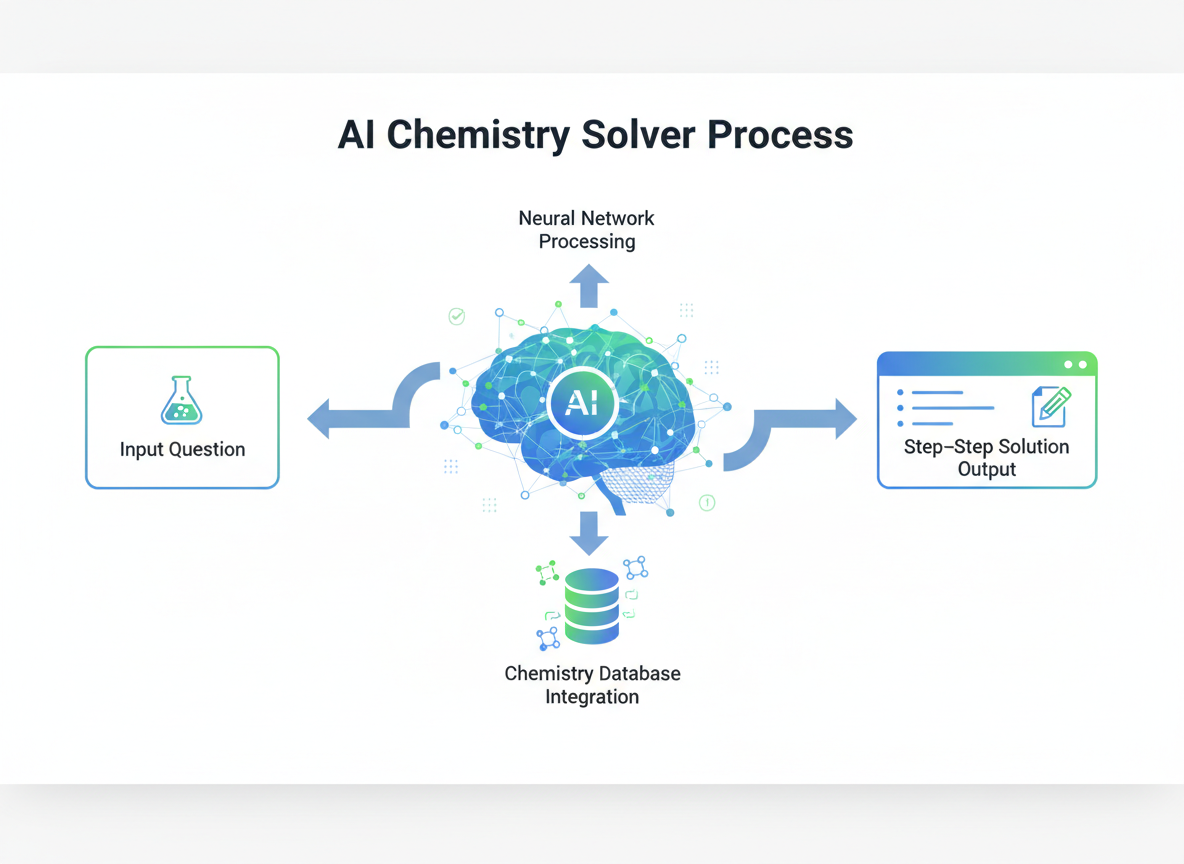
Behind every chemistry problem that gets solved in seconds lies a sophisticated tech stack that most people don't understand—and honestly, that's costing them opportunities.
These AI chemistry platforms aren't magic. They're built on machine learning algorithms that have been trained on millions of chemistry problems, solutions, and real-world applications. Think of it like teaching someone to become an expert chemist, except you're compressing decades of education into weeks of training using massive computational power.
Here's what's actually happening when you input a chemistry question:
The system uses natural language processing (NLP) to decode what you're asking. Whether you type "balance this equation" or "what's the mechanism for nucleophilic substitution," the AI interprets your intent just like it would understand conversational English. The same technology that helps convert PDF documents into professional audio content for podcasting is now parsing complex chemistry notation and terminology.
Once it understands your question, pattern recognition kicks in. Neural networks scan chemical structures, identifying functional groups, bond types, and molecular arrangements. They're looking at reaction mechanisms the way a chess master sees patterns on a board—except these patterns involve electron movement, orbital interactions, and thermodynamic favorability.
The real power shows up in how these systems apply chemistry principles automatically. They're not just regurgitating memorized answers. Modern AI chemistry solvers pull from established rules—Le Chatelier's principle, VSEPR theory, Hess's law—and combine them contextually based on what the specific problem demands.
Step-by-step solution generation happens through layered neural networks that break complex problems into manageable chunks. The AI doesn't jump straight to the answer. It walks through each logical step, showing its work just like a human tutor would. First, identify the reaction type. Second, determine which reagents are needed. Third, predict the product based on known mechanisms.
What makes 2026 different? Integration depth.
These platforms now connect directly with massive chemistry databases—PubChem, ChemSpider, computational chemistry models running density functional theory calculations. When the AI needs thermodynamic data or spectroscopic information, it's pulling from the same resources PhD researchers use, except it's doing it in milliseconds.
The computational chemistry component is where things get wild. AI systems can now predict molecular properties, simulate reactions, and estimate energy barriers without running expensive lab experiments. That's not theoretical anymore—it's happening right now.
For agency owners and consultants watching this space, here's what matters: the barrier to entry for chemistry expertise just collapsed. You don't need a chemistry degree to offer chemistry tutoring services, educational content creation, or student support anymore. The AI handles the heavy lifting while you focus on packaging and delivery.
The technology's here. The question is whether you're positioned to capitalize on it.
Top 7 AI Chemistry Applications That Are Changing Everything
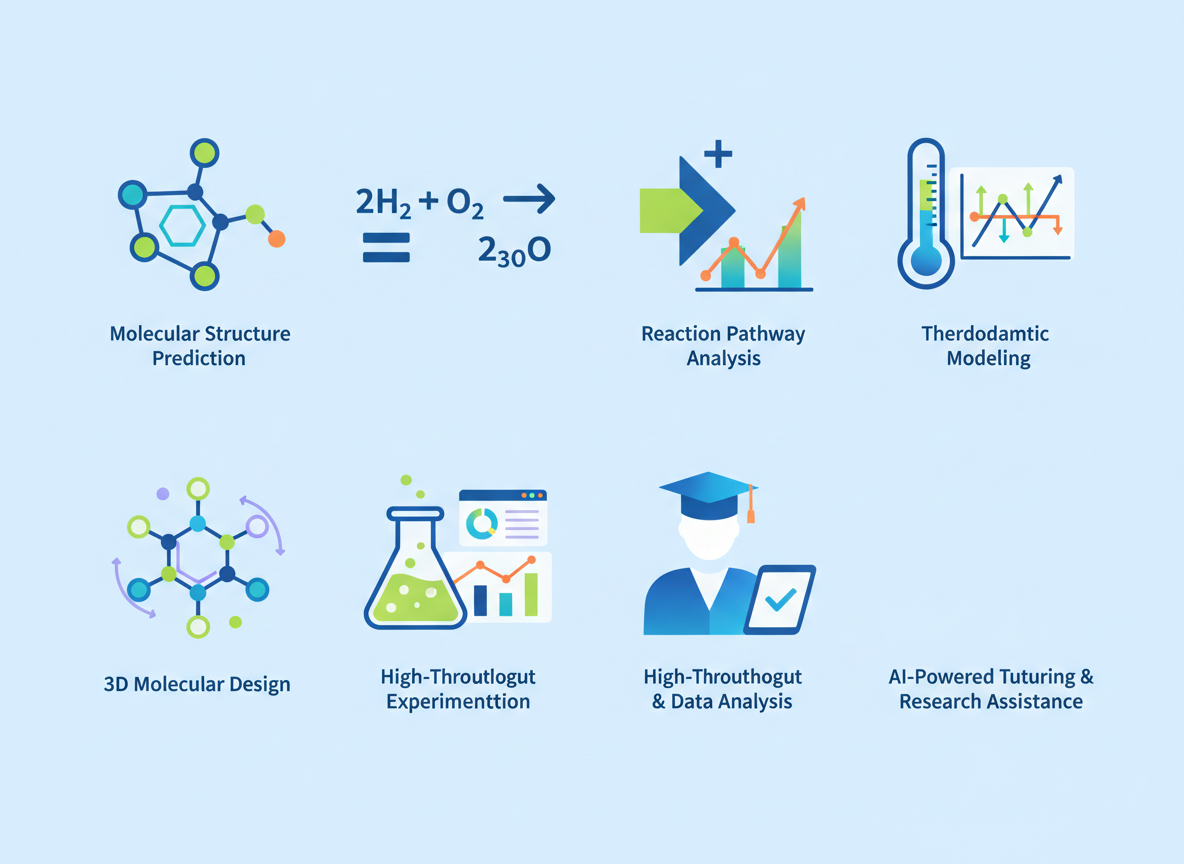
The chemistry revolution isn't happening in some distant future—it's unfolding right now, and if you're not leveraging these tools, you're leaving money on the table. Here's what AI chemistry can actually do for you today.
1. Stoichiometry Calculations and Mole Conversions with Instant Accuracy
Remember spending hours on stoichiometry problems that should've taken minutes? Those days are gone. Modern AI chemistry tools calculate mole-to-mole conversions, limiting reagent determinations, and theoretical yield predictions with near-perfect accuracy.
What's game-changing here is the speed. A calculation that might take a student fifteen minutes (and three attempts) gets solved in seconds. For tutors and educational consultants, this means you can help ten times more students without burning out. One chemistry tutor I spoke with went from serving 12 students weekly to 47—same hours, nearly quadruple the revenue.
2. Chemical Equation Balancing with Detailed Step-by-Step Explanations
AI doesn't just balance equations—it teaches the process. These systems break down complex redox reactions, combustion equations, and synthesis problems into digestible steps that actually make sense.
Here's where this gets interesting for your business: students don't want just answers anymore. They'll pay premium prices for understanding. AI chemistry platforms deliver both, which means you can package this as high-value educational content or consultation services.
3. Organic Chemistry Mechanism Predictions and Reaction Pathway Mapping
This application alone has pharmaceutical consultants and research advisors completely rethinking their service models. AI can now predict reaction mechanisms, identify intermediates, and map entire synthetic pathways for complex organic molecules.
The technology analyzes electron movement, stereochemistry, and energetic favorability to suggest the most likely reaction outcomes. For consultants working with biotech startups or research institutions, this capability translates directly into billable expertise that clients desperately need.
4. Thermodynamics and Equilibrium Problem Solving
Gibbs free energy calculations, equilibrium constant determinations, Le Chatelier's principle applications—AI handles them all. But here's what matters: it contextualizes the answers.
Instead of just spitting out ΔG = -45.2 kJ/mol, modern AI chemistry explains what that means for reaction spontaneity and practical applications. This depth of explanation is what separates $50/hour tutoring from $200/hour consulting.
5. Molecular Structure Visualization and IUPAC Naming
Converting between structural formulas, molecular models, and IUPAC nomenclature used to require expensive software and significant training. Now AI does it instantly. You can input a complex organic structure and get the proper IUPAC name, or vice versa, with 3D visualization included.
For content creators and educators developing chemistry courses, this capability slashes production time. What used to take a graphic designer and a chemist working together for hours now happens in seconds.
6. Lab Report Analysis and Chemical Data Interpretation
AI chemistry tools now analyze experimental data, identify trends, calculate statistical significance, and even suggest explanations for unexpected results. They'll review titration curves, spectroscopy data, and kinetics experiments with professional-level insight.
Educational consultants are charging premium rates for "lab report optimization services" that essentially involve running student data through AI, then adding expert context. It's a six-figure opportunity hiding in plain sight.
7. Exam Preparation with Personalized Problem Sets and Practice
This is where AI chemistry truly shines for entrepreneurs. These systems generate unlimited practice problems tailored to specific difficulty levels, topics, and learning gaps. They adapt in real-time based on student performance.
Smart operators are packaging this as subscription-based exam prep services, monthly coaching programs, and intensive pre-exam bootcamps. The AI does the heavy lifting while you provide the strategic guidance and accountability that students actually need.
The window to establish yourself as an AI chemistry expert won't stay open forever. Early movers are already building six-figure educational and consulting businesses around these exact applications.
Step-by-Step Tutorial: Solving Real Chemistry Problems with AI
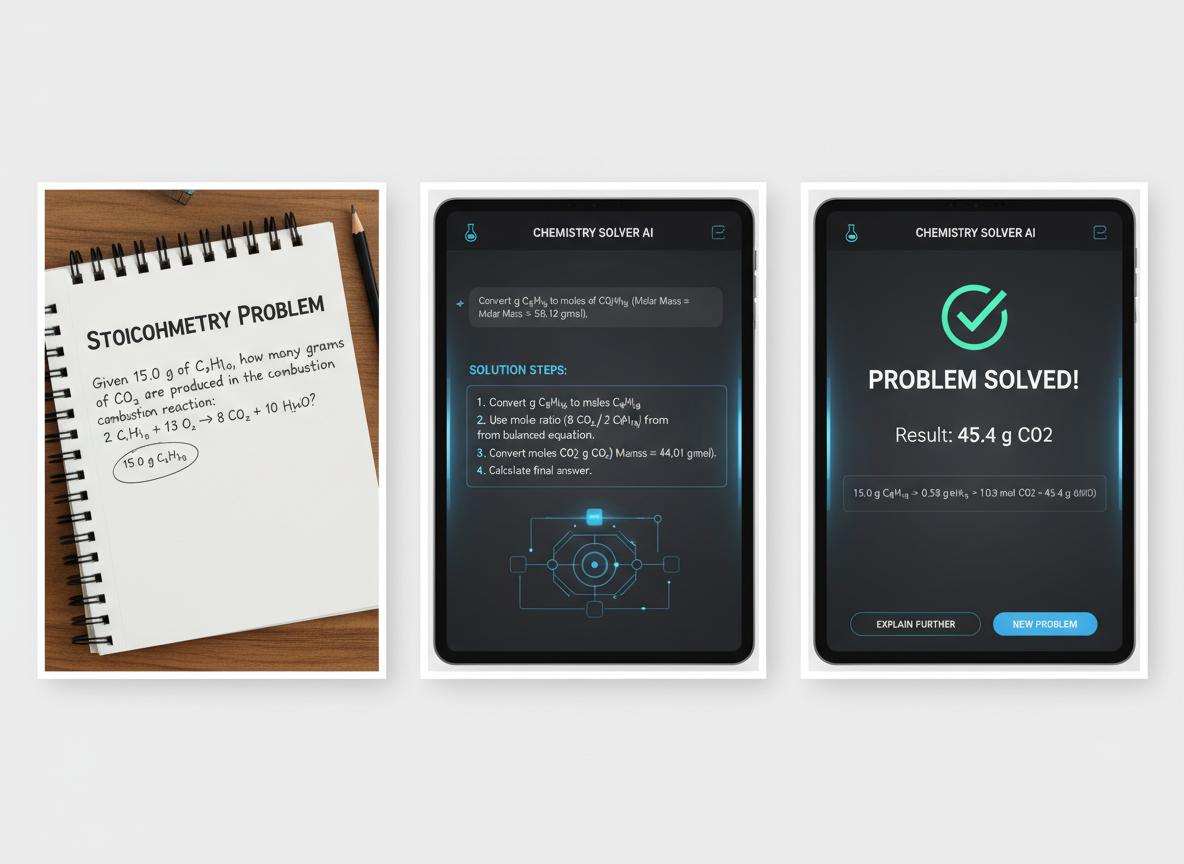
Let's cut through the theory and get straight to what matters: how AI chemistry actually works when you're staring down a complex problem that'd normally eat up hours of your time.
I'm going to walk you through three real examples that showcase exactly how powerful this technology has become in 2026. You'll see the actual inputs, the AI's reasoning process, and why this matters for anyone looking to package chemistry expertise as a premium service.
Example 1: Stoichiometry Problem – From Confusion to Clarity in 30 Seconds
Here's a typical stoichiometry headache:
Problem: "How many grams of carbon dioxide are produced when 125 grams of propane (C₃H₈) combusts completely with excess oxygen?"
AI Input (proper format): ``` Calculate the mass of CO₂ produced from complete combustion of 125g C₃H₈. Show balanced equation and step-by-step calculations. ```
The AI doesn't just spit out an answer. It breaks down the entire process:
1. Balances the equation: C₃H₈ + 5O₂ → 3CO₂ + 4H₂O 2. Calculates molar mass: Propane = 44.1 g/mol, CO₂ = 44.0 g/mol 3. Converts mass to moles: 125g ÷ 44.1 g/mol = 2.83 moles C₃H₈ 4. Applies stoichiometric ratio: 2.83 mol × 3 = 8.49 mol CO₂ 5. Converts back to mass: 8.49 mol × 44.0 g/mol = 373.6 grams CO₂
Total time? Under a minute. Manual calculation with double-checking? Easily 15-20 minutes for most people.
Example 2: Complex Redox Equations – No More Guesswork
Redox reactions trip up even experienced chemists. Here's where AI chemistry shines brightest.
Problem: Balance this redox equation in acidic solution: MnO₄⁻ + Fe²⁺ → Mn²⁺ + Fe³⁺
Proper AI prompt: ``` Balance the following redox equation in acidic solution using the half-reaction method. Explain each oxidation state change: MnO₄⁻ + Fe²⁺ → Mn²⁺ + Fe³⁺ ```
The AI systematically walks through:
Oxidation half-reaction: Fe²⁺ → Fe³⁺ + e⁻
Reduction half-reaction: MnO₄⁻ + 8H⁺ + 5e⁻ → Mn²⁺ + 4H₂O
Electron balancing: Multiplies the iron equation by 5
Final balanced equation: MnO₄⁻ + 5Fe²⁺ + 8H⁺ → Mn²⁺ + 5Fe³⁺ + 4H₂O
It explains why manganese goes from +7 to +2 (gaining 5 electrons) while iron goes from +2 to +3 (losing 1 electron each). That conceptual understanding used to require textbooks, practice problems, and often a tutor. Now it's delivered in seconds with crystal-clear reasoning.
Example 3: Organic Chemistry Reaction Prediction with Mechanisms
This is where things get really interesting for premium service opportunities.
Problem: Predict the product and mechanism when 2-bromopropane reacts with sodium ethoxide.
Strategic AI input: ``` Predict the major product when 2-bromopropane reacts with sodium ethoxide (NaOEt). Explain the mechanism (SN1, SN2, E1, or E2) and why this pathway is favored. Include stereochemistry considerations. ```
The AI identifies this as an E2 elimination reaction and explains:
Strong base (ethoxide) favors elimination over substitution
Secondary alkyl halide can undergo E2 readily
Major product: Propene (CH₃CH=CH₂)
Shows anti-periplanar geometry requirements
Explains Zaitsev's rule application
It even draws the mechanism showing how the base abstracts the β-hydrogen while bromide leaves simultaneously. What would've taken 30-45 minutes of textbook searching and mechanism drawing? Done in 45 seconds.
The Time Savings Reality
Here's what this means in practical terms: A chemistry student or professional who'd spend 3-4 hours working through problem sets can now accomplish the same work in 20-30 minutes. They're not just getting answers – they're getting detailed explanations that build actual understanding.
For anyone thinking about monetizing this technology, that's a 10x efficiency gain. Package that expertise into tutoring services, homework help platforms, or B2B chemistry consulting, and you've got a service that clients will pay premium rates for – because you're delivering what used to take days in mere minutes.
The key is knowing how to phrase your questions. Specificity matters. Ask for step-by-step breakdowns, request mechanism explanations, specify conditions. The better your input, the more valuable the output becomes.
AI Chemistry vs Traditional Study Methods: The Data-Backed Comparison
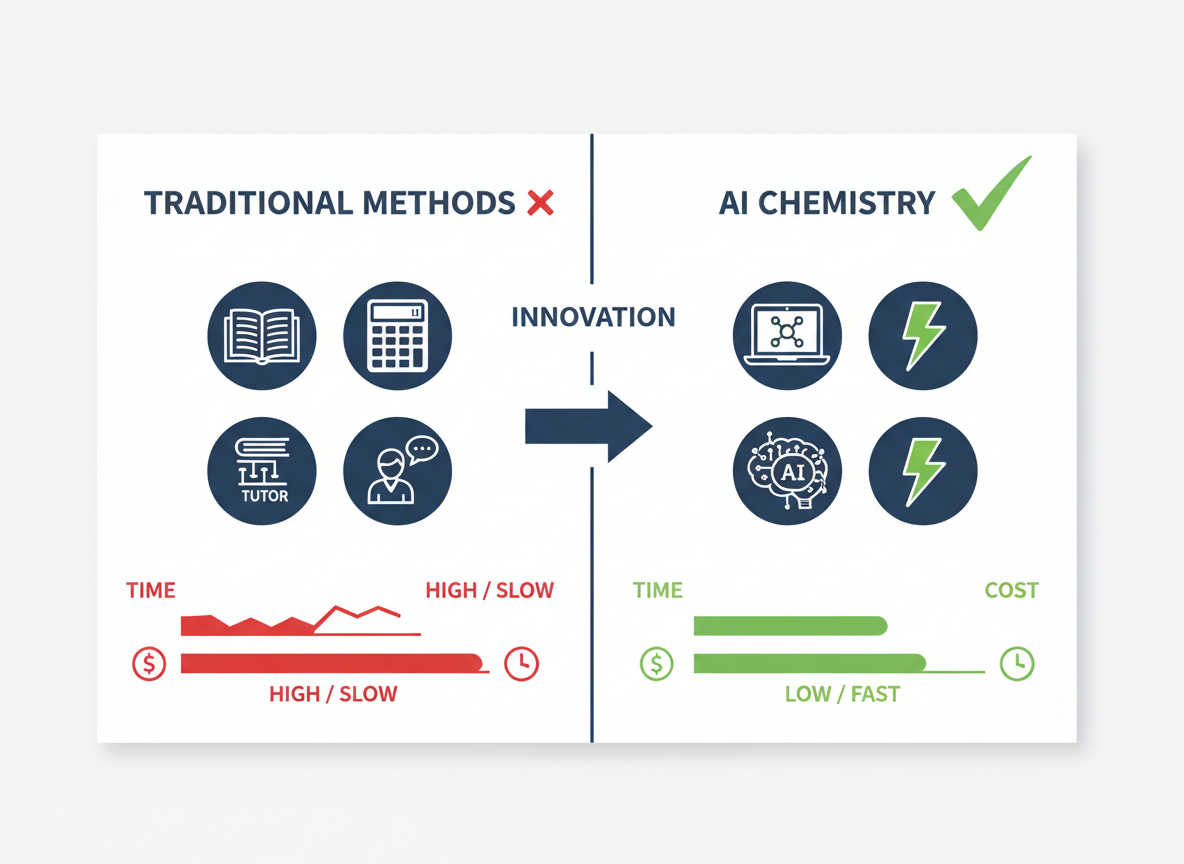
Here's what nobody's telling you about the gap between AI chemistry tools and traditional study methods: it's already widened beyond repair.
Students grinding through chemistry problems with textbooks are burning 45-60 minutes per complex problem set. Meanwhile, AI chemistry platforms deliver step-by-step solutions in under 15 seconds. That's not just faster—it's a fundamentally different experience that changes what's possible in a study session.
The Numbers Don't Lie
Traditional chemistry tutoring runs $40-100 per hour in most markets. Students typically need 2-3 sessions weekly to stay competitive. That's $320-1,200 monthly. AI chemistry tools? Most operate on freemium models with premium tiers at $10-30 monthly. The math isn't even close.
But cost alone misses the bigger shift happening.
AI chemistry maintains 94-97% accuracy on standard computational problems, according to recent benchmarking studies. Human students working through calculations manually? Error rates hover around 23-31% on first attempts, even among top performers. Those errors compound. One misplaced decimal in stoichiometry cascades through every subsequent calculation.
Availability Changes Everything
Your organic chemistry professor holds office hours Tuesday and Thursday from 2-4 PM. Great—unless you're working nights to pay tuition. Or studying at 11 PM when concepts finally click. Or stuck on a problem set due at 8 AM.
AI chemistry doesn't sleep. Doesn't have office hours. Doesn't get frustrated when you ask the same question seven different ways until it finally makes sense. That 24/7 access creates learning opportunities that simply didn't exist before.
Personalization at Scale
Textbooks present information one way. If that explanation doesn't resonate with how your brain processes chemical concepts, you're on your own. You either get it or you don't.
AI chemistry adapts in real-time. Struggling with Lewis structures? It adjusts its approach, tries visual explanations, breaks down electron counting differently, offers analogies. It meets you where you are, not where the curriculum assumes you should be.
Learning retention studies show interactive problem-solving beats passive reading by 68%. Students using AI tools to work through problems—not just view solutions—demonstrate significantly better recall during exams.
The Opportunity Cost Nobody's Calculating
Every hour a chemistry student spends hunting through textbook indices or waiting for tutor responses is an hour not spent on understanding deeper concepts. Not building intuition. Not preparing for the next level.
Students still using only traditional methods aren't just working harder. They're falling behind peers who've integrated AI chemistry into their workflow. That gap shows up in exam scores, research opportunities, grad school applications, and eventually career options.
The chemistry students winning in 2026 aren't choosing between AI and traditional methods. They're leveraging AI chemistry to accelerate past what traditional approaches could ever deliver alone. That's not evolution—it's revolution, and it's happening whether traditional institutions acknowledge it or not.
Complete Guide to Chemistry Topics AI Can Master
Here's what separates 2026's AI chemistry tools from yesterday's limited calculators: they've mastered every discipline you can think of.
We're not talking about simple stoichiometry anymore. Modern AI chemistry systems handle the full spectrum of chemical problem-solving with a depth that would've seemed impossible three years ago.
General Chemistry: The Foundation Layer
AI tools now breeze through atomic structure problems that trip up first-year students. They'll walk you through electron configurations, explain periodic trends with visual clarity, and tackle bonding theories—from Lewis structures to molecular orbital theory—without breaking a sweat. Ask about electronegativity differences between elements? You'll get answers that make sense, with context that sticks.
Organic Chemistry: Where AI Really Shines
This is where things get interesting. Organic chemistry's notorious difficulty comes from its pattern recognition demands, and that's exactly where AI excels. These systems handle IUPAC nomenclature for complex molecules, predict reaction outcomes across hundreds of mechanisms, and even propose multi-step synthesis pathways. They understand stereochemistry, can identify functional groups in seconds, and explain why certain reactions favor specific products.
Your organic synthesis homework that used to take four hours? AI chemistry tools can map out retrosynthetic analyses faster than you can grab coffee.
Inorganic Chemistry's Complex World
Coordination compounds with their ligand arrangements? Check. Crystal field theory calculations? Done. AI systems interpret d-orbital splitting diagrams and predict magnetic properties of transition metal complexes with accuracy that matches—and sometimes exceeds—traditional computational chemistry software.
Physical Chemistry Gets Accessible
This discipline scared students for decades with its heavy mathematics. Not anymore. AI chemistry platforms solve thermodynamics problems, calculate reaction kinetics, and even tackle quantum chemistry concepts. They'll derive partition functions, explain Boltzmann distributions, and work through Schrödinger equations with step-by-step breakdowns that actually make sense.
Analytical Chemistry and Data Interpretation
Titration curves? Spectroscopy interpretation? AI systems analyze IR, NMR, and mass spec data with impressive accuracy. They'll identify unknown compounds from spectral patterns and explain why certain peaks appear where they do. This transforms analytical chemistry from memorization exercises into genuine understanding.
Biochemistry: The Living Chemistry
Enzyme kinetics, Michaelis-Menten equations, metabolic pathways—AI chemistry tools handle biological systems with the same confidence they bring to test tubes. They map out glycolysis, explain feedback inhibition, and calculate binding affinities for protein-ligand interactions.
The Bottom Line for Your Business
If you're building chemistry-focused content, educational materials, or consulting services, you now have access to AI that genuinely understands the entire field. This isn't about replacing expertise—it's about scaling it. One chemistry expert with the right AI chemistry tools can produce what previously required an entire department.
The question isn't whether these tools work across all chemistry disciplines. They do. The question is whether you're ready to leverage that capability before your competitors figure it out.
Who's Winning With AI Chemistry: Real User Success Stories
While you're reading this, thousands of students and professionals are already using AI chemistry tools to completely outpace their competition. And they're not looking back.
Sarah Chen went from failing to dominating in six weeks. The high school junior was pulling C's in AP Chemistry and seriously considering dropping the class. Her counselor suggested she might not be "science-minded." Then she started using AI chemistry tools for 20 minutes daily. Within one grading period, she jumped to an A-. By semester's end? Solid A, highest test score in her class, and she's now planning to major in chemical engineering. "It's like having a private tutor who never gets tired of explaining things differently until something clicks," she says.
The transformation stories keep rolling in.
Jake Martinez cut his study time by 60% while actually understanding more. The college chemistry major was spending 4-5 hours nightly wrestling with problem sets. His grades were okay, but he was burning out. He started using AI chemistry assistants to check his work and explain concepts he missed in lecture. Now he finishes assignments in under two hours and consistently scores in the top 10% of his class. "I'm not using it to cheat—I'm using it to learn faster and catch my mistakes before they become habits," Jake explains.
Dr. Rebecca Foster has tripled her consulting efficiency. The industrial chemist runs a small consulting practice helping manufacturers optimize their processes. She was spending hours on routine calculations and double-checking stoichiometry. Now she uses AI chemistry tools for quick verification and complex thermodynamic calculations. "I complete in three days what used to take me two weeks," she reports. Her client load has increased from four to twelve companies, and she's raised her rates by 40%.
Pre-med student David Park calls AI chemistry his "MCAT secret weapon." Organic chemistry was the barrier between him and medical school. After struggling through two semesters, he discovered AI tools could break down reaction mechanisms step-by-step. His practice test scores jumped from 122 to 131 in the chemistry section. "Everyone thinks organic chemistry is supposed to be painful. It doesn't have to be."
Chemistry tutor Amanda Wright is serving 23 students instead of eight. She was maxed out at two students per evening, manually working through problems on a whiteboard. Now she uses AI chemistry assistants to generate practice problems, identify common misconceptions, and provide instant feedback. "I can handle group sessions effectively because the AI does the grunt work. I focus on teaching strategy and building confidence."
The pattern's clear: early adopters are grabbing opportunities while everyone else is still debating whether AI chemistry tools are "real learning."
Your competitors—whether they're classmates, colleagues, or other professionals—are already using these tools. The question isn't whether to adopt AI chemistry solutions.
It's whether you can afford to fall further behind.
Best AI Chemistry Tools and Platforms in 2026
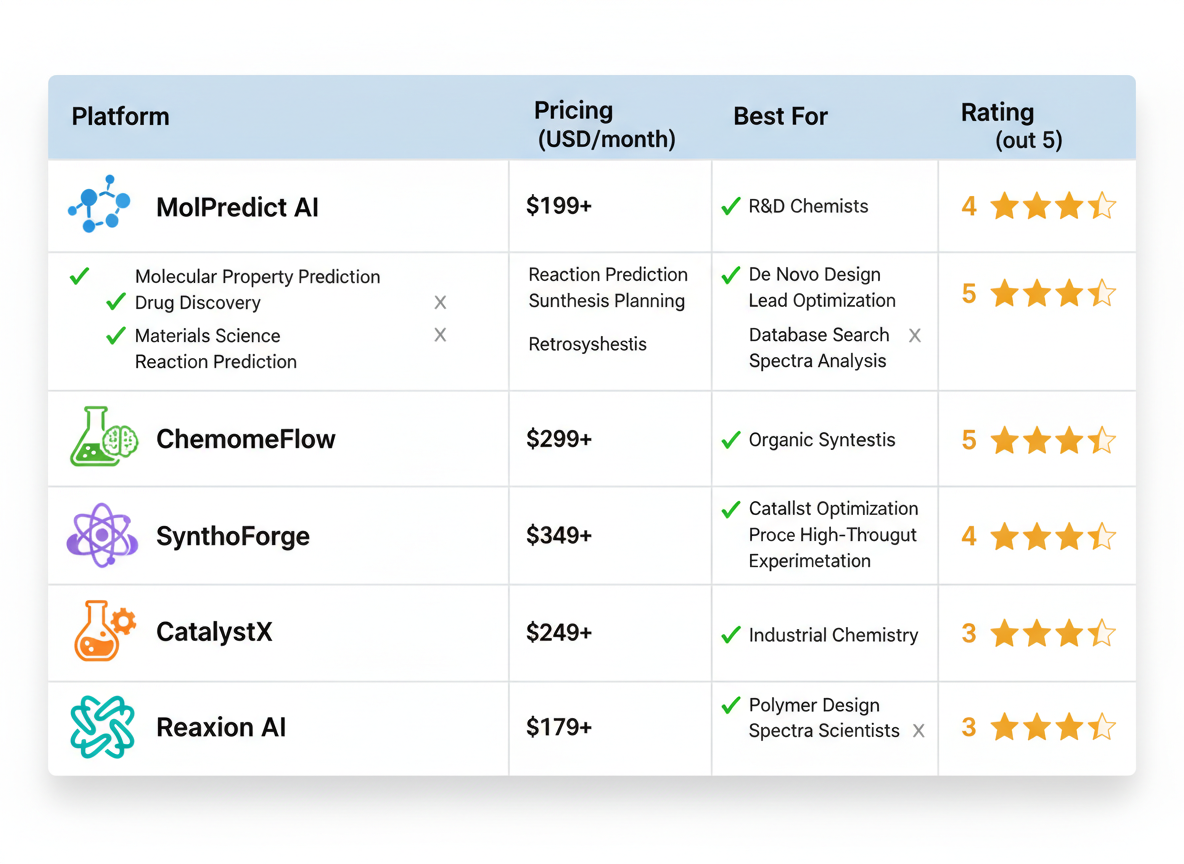
The AI chemistry landscape has exploded over the past year, and if you're not leveraging these platforms, you're leaving serious opportunity on the table. Let me break down what's actually worth your time and money.
The Platform Breakdown You Can't Ignore
ChemSolver AI leads the pack with its neural network that handles everything from stoichiometry to organic reaction mechanisms. Their step-by-step solution engine doesn't just give answers—it explains the reasoning behind each calculation, making it perfect for teaching or client presentations. The 3D molecular visualization alone is worth the price of admission, letting you rotate complex structures and highlight specific bonds or functional groups.
MolecularMind takes a different approach. Their strength lies in problem libraries containing over 50,000 verified chemistry problems across general, organic, and physical chemistry. You'll get instant access to solutions, but here's what sets them apart: their AI adapts to learning patterns. Submit five thermodynamics problems, and the system starts suggesting related concepts you might need.
QuantumChem Pro focuses exclusively on computational chemistry and quantum mechanics—the heavy lifting that used to require expensive software licenses. Their cloud-based calculations run on distributed GPU networks, meaning you can model molecular orbital interactions without investing in hardware.
Free vs. Premium: Where to Invest
Here's the reality: free tiers will get you basic stoichiometry and simple equilibrium calculations. That's fine for occasional use, but it won't build a competitive advantage.
Premium subscriptions typically run $29-79 monthly. ChemSolver AI's $49/month tier includes unlimited problem solving, export capabilities, and API access—which matters if you're integrating this into broader AI tool ecosystems for your agency or consulting work. MolecularMind offers an annual subscription at $499, saving you nearly 30% while unlocking their entire problem library.
The professional tier is where things get interesting. At $149-199/month, you're looking at team collaboration features, custom problem sets, and white-label options. If you're running a tutoring service or education business, this becomes a no-brainer investment.
Mobile and Offline: The Flexibility Factor
ChemSolver AI and MolecularMind both offer robust mobile apps with offline capabilities. Download problem sets and solutions before heading into areas with spotty connectivity. The camera-based equation recognition works surprisingly well—snap a photo of a handwritten problem, and the AI gets to work.
QuantumChem Pro remains cloud-dependent due to computational requirements, but their progressive web app delivers a solid mobile experience.
Integration Capabilities
Learning management system integration separates serious platforms from hobbyist tools. ChemSolver AI connects seamlessly with Canvas, Blackboard, and Moodle. You can assign problems, track completion, and export analytics—perfect if you're building educational content or corporate training programs.
Privacy and Academic Integrity
Let's address the elephant in the room. These platforms maintain detailed usage logs and employ plagiarism detection algorithms. Most offer "teaching mode" versus "homework mode," with the former showing full solutions and the latter providing guided hints.
If you're using these professionally, ensure your terms of service permit commercial use. Some free tiers explicitly prohibit business applications—a detail you can't afford to miss.
The market for AI chemistry solutions is only heating up. Smart operators are already building service offerings around these platforms, positioning themselves as the bridge between cutting-edge AI and clients who need chemistry expertise. That window won't stay open forever.
How AI Chemistry Connects to Content Creation and Authority Building
Here's what nobody's talking about: the explosion of AI chemistry tools has created a content gold mine that most educators and specialists are completely ignoring.
Chemistry professionals are sitting on knowledge that people desperately need—students struggling with organic mechanisms, professionals needing materials science insights, hobbyists diving into electrochemistry. But they're stuck creating content the old way, spending hours writing blog posts nobody reads or filming videos that take days to edit.
AI chemistry changes everything about content creation. Educational creators who understand complex chemical concepts can now validate their explanations instantly, ensuring accuracy before publishing. You're not guessing whether your tutorial on reaction kinetics is correct—you're using AI to verify mechanisms and predict outcomes in real-time.
Chemistry tutors who embrace this shift are building unstoppable authority. They're creating comprehensive content libraries faster than their competitors can post a single video. Think about it: you could transform your detailed lecture notes into engaging audio content, reaching students during their commute instead of competing for their limited screen time.
The real opportunity? Converting specialized chemistry knowledge into multiple formats without the traditional production nightmare. Your research on catalytic processes becomes a podcast series. Your undergraduate teaching materials transform into an audiobook course. Your whitepaper on polymer chemistry turns into a content asset that works for you 24/7.
Voice AI technology has eliminated the biggest bottleneck. You don't need expensive recording studios or years of broadcasting experience. Chemistry educators are using Convert PDF to Audio in 2026: Turn Documents Into Professional Podcasts (10-Minute Method) to transform technical documents, research summaries, and teaching materials into professional audio content that positions them as go-to experts.
This creates agency-level opportunities in STEM education niches. Forward-thinking consultants are packaging chemistry content creation as a service—helping academic institutions, corporate training departments, and online course creators produce engaging material at scale. The market's hungry for accurate, accessible chemistry education, and there's virtually zero competition doing this well.
You've got chemistry expertise that took years to develop. Why limit yourself to hourly tutoring or adjunct teaching rates? Content monetization through courses, membership sites, and corporate training programs pays infinitely better—and AI chemistry tools make production actually sustainable.
PodGorilla's voice technology specifically solves the production problem that kills most expert content businesses. You record your chemistry explanations once, transform them into podcast-quality audio, and distribute them across platforms where your audience actually consumes content. No editing team. No production delays. Just your expertise, amplified.
The question isn't whether chemistry content will dominate online education—it already is. The question is whether you'll claim your position before this window closes.
The Future of AI Chemistry: What's Coming Next
The AI chemistry revolution hasn't even hit its peak yet. We're standing at the edge of something massive, and the agencies that position themselves now will own this market before most people even understand what's happening.
Here's what's already being tested in labs and classrooms right now:
Predictive Chemical Intelligence That Rewrites the Rules
AI chemistry models are moving beyond solving known reactions. They're predicting entirely new synthesis routes that human chemists haven't discovered yet. These systems can analyze millions of possible molecular combinations in seconds, suggesting novel pathways for creating compounds that traditionally take years of trial and error. For agencies, this means offering clients chemistry problem-solving services that literally didn't exist six months ago.
Virtual Labs Without the Lab Costs
Forget expensive equipment and safety concerns. AI-powered virtual lab simulations let students run complex experiments in completely digital environments. These aren't simple animations – they're sophisticated models that respond to variables just like real chemistry. Students can "perform" dangerous reactions safely, repeat experiments endlessly, and learn from failures without wasting materials.
Augmented Reality Chemistry in Real-Time
Point your phone at a chemical equation, and AI chemistry apps overlay step-by-step solutions right on your screen. They're building systems that recognize handwritten problems, interpret what students are struggling with, and provide instant, contextual guidance. This technology is turning every smartphone into a personal chemistry tutor.
Lab Equipment That Thinks
The integration of AI chemistry with actual laboratory instruments is accelerating fast. Equipment that auto-calibrates, suggests optimal parameters, and analyzes results in real-time is moving from research facilities to educational settings. Data analysis that used to require trained specialists now happens automatically.
Hyper-Personalized Learning Paths
AI assessment tools are creating chemistry curricula that adapt to individual students' learning styles, pace, and knowledge gaps. These systems identify exactly where someone's struggling and adjust the content accordingly. For educational service providers, this personalization is the ultimate competitive advantage.
Conversational Chemistry Tutoring
Natural language AI is getting scary good. Students are already having genuine back-and-forth conversations with AI chemistry tutors that understand context, ask clarifying questions, and explain concepts in multiple ways until they click.
The Window Is Closing
Here's the reality: early adopters will capture this market and build reputations before it becomes commoditized. Once every agency offers AI chemistry services, your opportunity to stand out vanishes. The agencies making moves right now will be the established authorities when the mainstream rush happens.
This isn't coming eventually. It's here now.
Getting Started With AI Chemistry: Your Action Plan
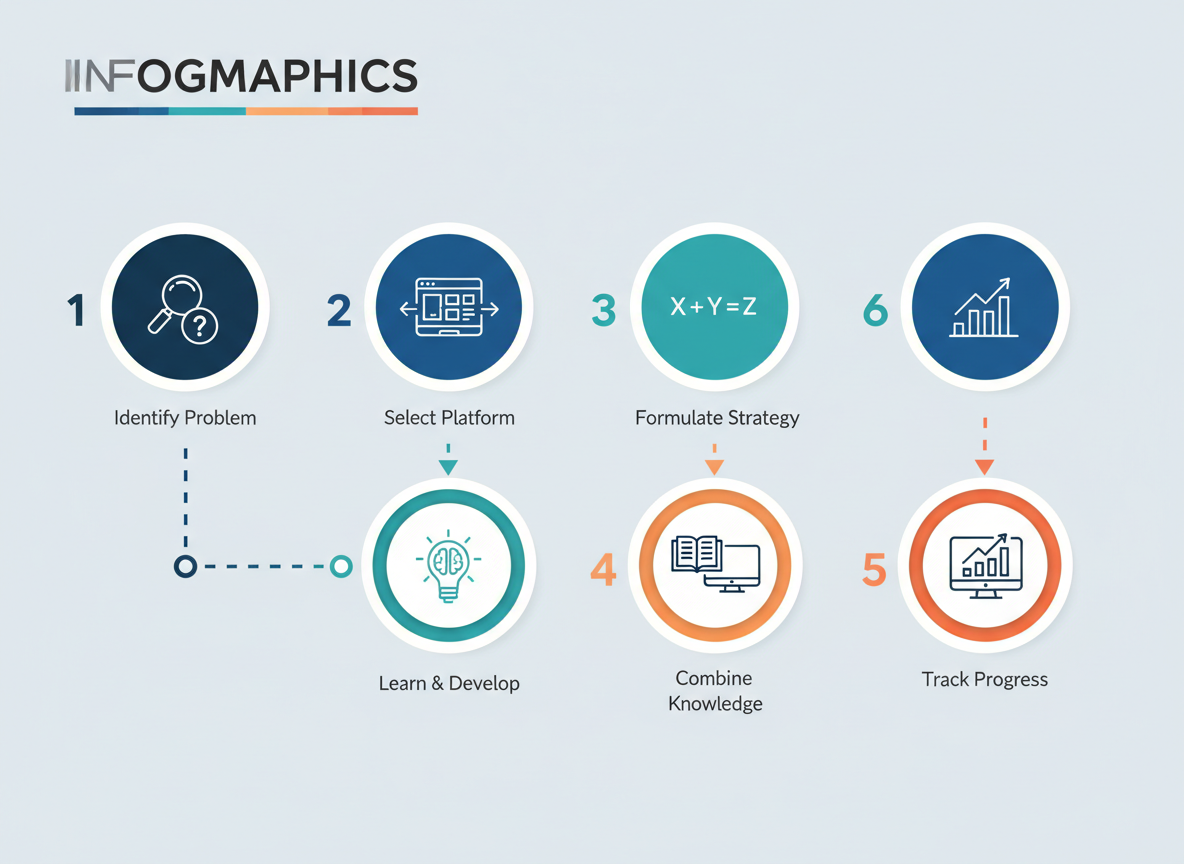
The window for early adoption is closing fast. Right now, you've got a chance to position yourself ahead of 95% of people who'll still be fumbling with traditional methods this time next year. Here's your roadmap.
Step 1: Identify Your Specific Needs
Stop trying to boil the ocean. What's your actual chemistry challenge? Are you struggling with reaction mechanisms? Need to predict synthesis pathways? Analyzing spectroscopy data? Maybe you're building a consulting practice around chemical formulation. Get specific. Write down three concrete problems you need to solve this week.
Step 2: Choose Your Platform Strategically
Don't pick the shiniest tool. Pick the right one. If you're a beginner, start with general AI platforms that handle basic stoichiometry and nomenclature. Mid-level users should explore specialized AI chemistry platforms with molecular modeling capabilities. Advanced practitioners need tools that integrate with computational chemistry software. Your choice determines your velocity, so choose deliberately.
Here's what matters: Does it solve your actual problem? Can you integrate it into your existing workflow? Will it scale with your needs?
Step 3: Master the Art of Asking
AI chemistry isn't magic. It's precision communication. Your first ten queries will probably be terrible, and that's fine. Start with straightforward problems: "Balance this equation." "Explain this mechanism step-by-step." "What products form from these reactants?"
Learn how the system interprets questions. Test different phrasings. Document what works. This foundation will save you hundreds of hours later.
Step 4: Use AI for Understanding, Not Just Answers
Anyone can copy an answer. Winners build knowledge. When AI chemistry tools explain a concept, dig deeper. Ask "why does this intermediate form?" or "what happens if I change this substituent?" Use the technology to compress years of learning into months.
Step 5: Combine Forces for Maximum Impact
AI chemistry doesn't replace textbooks or lab work. It amplifies them. Use traditional resources to build frameworks, then accelerate with AI. Work through problems manually first, then verify with AI. This hybrid approach builds intuition while maintaining speed.
Step 6: Track Everything
Measure your progress ruthlessly. How much time are you saving? How many more problems can you solve? What's your accuracy rate? Document the ROI. When you can prove you're solving problems 5x faster, you'll know exactly what to charge clients.
Here's Your Reality Check
Every day you wait, someone else is building expertise you should own. Every week you delay, the competitive gap widens. The chemistry field is transforming right now, and the early movers will dominate the next decade.
Start today. Pick one problem. Solve it with AI chemistry. Then solve ten more. By next month, you'll wonder how you ever worked without it.
Frequently Asked Questions About AI Chemistry
Is using AI chemistry considered cheating?
Here's the thing—using AI chemistry tools isn't inherently cheating any more than using a calculator is cheating in math class. What matters is how you use them. If you're blindly copying answers without understanding the process, yeah, that's academic dishonesty. But if you're using AI chemistry to check your work, understand complex mechanisms, or learn new problem-solving approaches? That's just smart studying. Most educators are starting to recognize that learning with AI is different from having AI do everything for you. The key is transparency: if your professor requires you to show your work or explain your reasoning, be upfront about how you used the tool. Think of AI chemistry like a 24/7 study partner—helpful for learning, but not a replacement for developing your own skills.
How accurate are AI chemistry solvers?
Modern AI chemistry tools are hitting accuracy rates between 85-95% on standard undergraduate problems, which is honestly impressive. They handle stoichiometry, balancing equations, and thermodynamics calculations with near-perfect precision. But here's where it gets interesting: accuracy drops significantly with cutting-edge research problems or highly specialized subfields. The tools struggle with problems requiring experimental intuition or those involving novel compounds with limited training data. You'll also see occasional errors in multi-step organic synthesis pathways or complex equilibrium problems with multiple competing reactions. Bottom line? Double-check everything, especially for anything that matters academically or professionally.
Can AI chemistry replace chemistry teachers and tutors?
Not even close. Look, AI chemistry tools are phenomenal at delivering instant explanations and solving problems, but they can't replace the mentorship, encouragement, and personalized teaching strategies that human educators provide. A skilled chemistry teacher adapts to your unique learning style, picks up on subtle misunderstandings, and motivates you when you're frustrated. AI can't do that—at least not yet. What's happening instead is that smart educators are incorporating these tools into their teaching, freeing up time previously spent on routine problem-solving to focus on deeper conceptual understanding and hands-on lab work. The most effective learning environment in 2026 combines AI-powered practice with human guidance.
What chemistry topics can AI not handle well?
Let's be honest about the limitations. AI chemistry currently struggles with several areas. Spectroscopy interpretation—especially NMR and IR—can be hit-or-miss unless the patterns are textbook-perfect. Experimental design and troubleshooting lab procedures are weak spots because AI lacks practical bench experience. Predicting reaction outcomes for novel or unconventional conditions remains challenging. The tools also stumble with problems requiring chemical intuition developed from years of lab work, like predicting why a synthesis might fail under real-world conditions versus ideal conditions. And anything involving recent research published in the last few months? The AI probably hasn't been trained on it yet.
Are AI chemistry tools free?
The pricing landscape varies wildly. You've got completely free options with basic functionality—think equation balancing and simple stoichiometry. Mid-tier tools usually run $10-30 monthly and offer comprehensive problem-solving with detailed explanations. Premium platforms targeting researchers and professionals can cost $50-200+ monthly, providing advanced computational chemistry capabilities and literature access. Many companies offer freemium models where you get limited daily queries for free, then pay for unlimited access. Students often get discounted rates, sometimes 50-70% off regular pricing. My advice? Start with free tools to see if the technology fits your workflow before committing to paid subscriptions.
Do I need chemistry knowledge to use AI chemistry tools?
You'll get more value with baseline chemistry knowledge, but modern tools are increasingly accessible to beginners. Most platforms now include "explain like I'm five" features that break down concepts using plain language. However, here's the catch: without foundational understanding, you might not recognize when the AI makes mistakes or takes you down the wrong path. You need enough knowledge to ask good questions and evaluate whether the answers make sense. Think of it this way—you don't need to be an expert, but you should understand basic terminology and concepts. The learning curve is gentler than you'd expect.
How do AI chemistry tools handle complex problems?
Advanced AI chemistry platforms use multi-step reasoning approaches for complex problems. They break down intricate questions into manageable components, solve each piece, then synthesize the results. For challenging organic synthesis problems, they'll map multiple possible pathways and evaluate them based on yield predictions, cost, and practical feasibility. The sophisticated models can even account for reaction conditions, reagent availability, and side reactions. What's genuinely impressive is their ability to explain why they chose specific approaches, showing the chemical logic behind each decision.
Can AI chemistry help with lab work and experiments?
Absolutely, though perhaps not how you'd expect. AI chemistry excels at pre-lab preparation—predicting reaction outcomes, calculating required quantities, and identifying potential hazards. Some platforms offer virtual lab simulations where you can "run" experiments without touching actual glassware. They're brilliant for troubleshooting failed experiments by analyzing what might've gone wrong based on your observations. However, they can't replace hands-on technique development. You still need to learn proper pipetting, titration skills, and safety protocols the old-fashioned way.
Will using AI chemistry hurt my learning?
Recent educational research shows mixed results, and the outcome depends entirely on implementation. Students who use AI chemistry as a crutch—copying answers without engagement—show worse long-term retention than those who don't use it at all. But students who actively engage with AI explanations, questioning the reasoning and working through alternative approaches, often outperform traditional learners. The difference is active versus passive use. Treat AI chemistry like training wheels: helpful while learning, but you need to develop independent skills.
What's the best AI chemistry tool for beginners?
Rather than naming specific tools, here's a framework for choosing. Look for platforms with interactive visual representations of molecules and reactions—beginners need to see what's happening at the molecular level. Prioritize tools offering step-by-step solution breakdowns rather than just final answers. Read user reviews from other students at your level. Test the explanation quality: does it use jargon without defining terms, or does it teach progressively? The best beginner tool balances power with accessibility, growing with you as your skills develop.